





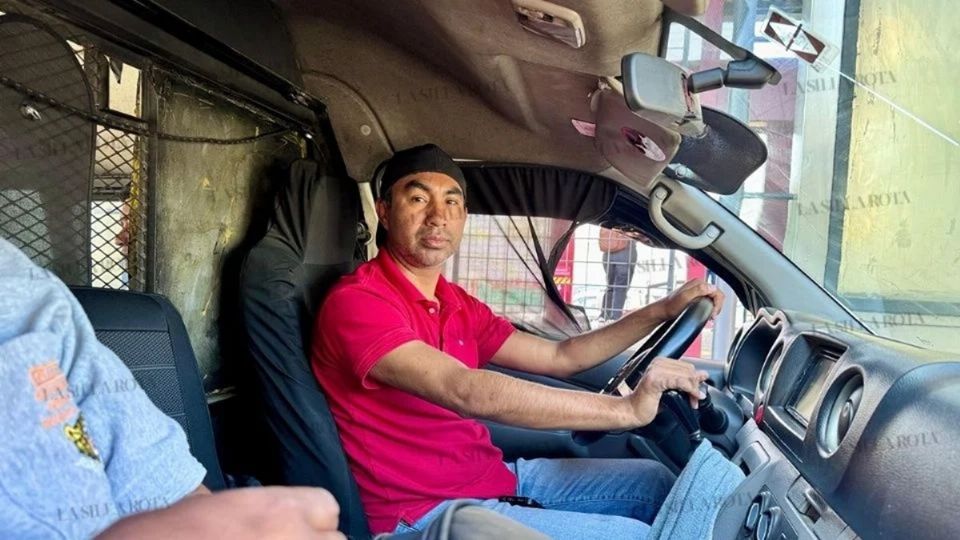

Miles away from the negotiation tables between transport leaders and the federal government, on López Portillo Avenue in Ecatepec, Juan Gabriel Sánchez recalls the times when his colleagues have fallen victim to crime.
“They cut us off, steal our vehicles, and sometimes take the driver—they disappear them for one, two, or even three days… sometimes they come back, and sometimes they don’t.”
His complaint, echoed by the sector for years, sparked a protest on Monday, November 24, that left thousands of drivers stranded and cut public transport drivers' income by up to 50%. Despite the losses, many of them supported the protest.
Te podría interesar
In an interview with La Silla Rota, Sánchez explains that road insecurity has worsened in both frequency and violence. He says his colleagues have been intercepted on routes like Arco Norte, Puebla, and Texmelucan, where armed groups block roads, seize vehicles, and detain drivers for days.
Frustration over the lack of answers led to the closure of lanes.
Te podría interesar
“Some authorities tell us that blocking the roads completely is the only way to get them to listen,” Sánchez says.
For the protesters, the blockade is a last resort to demand safety and a concrete plan to stop thefts and kidnappings.
While the truckers increase pressure on the government, public transport drivers are feeling the financial pain. Many people stayed home in fear of blocked roads.
Luis Leo Martínez, who drives a van between Puente de Fierro and Coacalco, estimates that he lost half his usual earnings and recalls having been robbed twice himself—especially on the Vía Morelos. Still, he supports the protest:
“There’s insecurity everywhere, even in public transport.”
Similarly, Roberto, a driver who usually makes about 400 pesos a day, only made 180 during the protest.
“People didn’t go out to work,” he explains. He too has been robbed twice. “The blockade is okay; there are too many robberies.”
Rosendo Martínez and Marco Antonio report similar numbers. They estimate a 50% drop in passenger numbers, with many vehicles running nearly empty.
Both agree that, even though the blockade hurts them financially, the demand for security is legitimate.
“They’re the ones traveling on highways; they have the right,” says Marco Antonio.
Road Blockades and Traffic Disruptions
The protest was organized by the National Association of Truckers (ANTAC), in conjunction with peasant groups like the National Front for the Rescue of the Mexican Countryside (FNRCM) and the Agricultural Peasant Movement.
The reported road closures were concentrated in several major roads in the State of Mexico and federal highways, affecting access to Mexico City.
Blockades began around 6:30 a.m. on José López Portillo Avenue and the Texcoco–Lechería federal highway, where trucks and drivers occupied central lanes.
Other blockades were reported on Arco Norte and stretches between Puebla and Texmelucan, routes that truckers have long labeled as high-risk areas due to frequent assaults and violence.
Additional demonstrations and disruptions occurred on the Mexico–Toluca Highway and other entry points to central Mexico.
TAMBIÉN LEE: Transportistas advierten nuevos bloqueos si Segob incumple exigencias
Protests Across Several States Demand Security and Fair Prices
Protests in Chihuahua, Sonora, Sinaloa, Guanajuato, and Tamaulipas, among other states, led to roadblocks, sit-ins, and public gatherings to demand better security, agricultural support, and solutions to local issues.
These mobilizations, led by farmers, truckers, and citizen groups, disrupted transit in key zones and pressured state governments to open dialogue tables.
Truckers Reaffirm Willingness to Talk
The National Alliance of Truckers and Freight Haulers (ANTAC) expressed its dissatisfaction, noting that although the Interior Ministry (Segob) announced the creation of dialogue spaces, none of their members have been invited.
In a statement, the organization stressed that their mobilizations are not politically motivated, but rather arise from a basic demand:
“We wish we didn’t have to demand something that’s already our right: not to be robbed, extorted, murdered, or disappeared.”
ANTAC warned that dozens of drivers are victims of crimes every day while working to support their families—a situation that affects not only the transport sector but anyone who travels through cartel-controlled roads.
“Sorry if this offends you, but every day, men and women who go to work become victims of a crime,” they said.
The organization reiterated that their movement is not meant to disturb the public or confront the government.
“This is not political. We promise that if you can manage to stop us from getting killed just for working, many of us would vote for you.”
ANTAC reaffirmed its openness to dialogue, but only if there’s a formal invitation and clear responses to their demands for safety on national routes.
TAMBIEN LEE: Pide Segob evitar megabloqueos de transportistas y productores
Interior Ministry Says Protests Are Politically Motivated, Calls for Dialogue
Interior Secretary Rosa Icela Rodríguez claimed there is no valid reason for the ongoing road blockades by farmers and truckers, which have affected multiple regions of the country in recent days.
She insisted that the federal government has maintained open and unrestricted dialogue, and said that the protests have political motives, led by figures linked to opposition parties.
At a press conference—attended by Agriculture Secretary Julio Berdegué Sacristán, Undersecretary César Yáñez, and Conagua Director Aaron Mastache—Rodríguez said the protests come from just three organizations, whose leaders, she claimed, are affiliated with or have ties to the PRI, PAN, and PRD.
VGB