






In Mexico's geography of violence, the periphery is often either the final destination of criminal purges or the discreet point of origin for illicit goods. In southwestern Morelos, however, the periphery has become a Gordian knot—an entrenched problem that has proven impossible to untangle. Systematically neglected by authorities at all three levels of government, this stretch of territory is now known by its own residents as "the Corridor of Death."
Here, state authority has dissolved into a troubling paradox: mayors, ejido commissioners, and small business owners not only share the same geographic space but also the status of paying tribute to organized crime. Institutionalized extortion—known in Mexico as derecho de piso, or protection payments—has become the de facto tax governing the local economy, collected alike by drug trafficking cells and, according to investigators, by municipal officials themselves.
The strategic importance of this roughly 20-kilometer (12-mile) corridor extends far beyond the regional economy. According to intelligence files, it serves as the principal gateway for high-powered weapons and drug shipments traveling from the neighboring states of Guerrero and Michoacán to criminal markets in Mexico City.
Te podría interesar
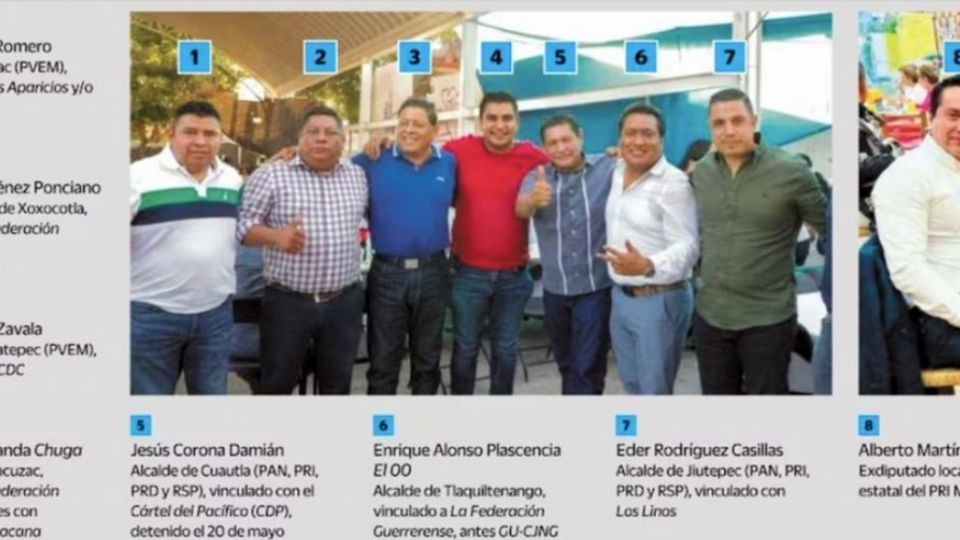
Details of this alleged institutional capture are contained in criminal intelligence files compiled as part of Operation Enjambre, a judicial offensive launched this year in Morelos. The investigation has exposed alleged networks linking local political power and organized crime, leading so far to the arrests of three sitting mayors and four former mayors.
ALSO READ: "Brother Wang": His Appetite for Risk Led Him Into Fentanyl Trafficking
Authorities continue to investigate more than a dozen additional municipal governments. The ongoing inquiry reportedly includes the municipalities of Ocuituco, Tetela del Volcán, Temoac, Jonacatepec, Ayala, and Axochiapan, all located in eastern Morelos.
Officials arrested under Operation Enjambre
Agustín Toledano Amaro (Sitting mayor of Atlatlahucan)
Date of arrest: May 20, 2026
Charges: Organized crime, extortion, arms trafficking, embezzlement of public funds, and alleged participation in a political structure that enabled criminal financing of election campaigns.
Irving Sánchez Zavala (Former mayor of Yecapixtla)
Date of arrest: May 20, 2026
Charges: Organized crime, extortion, embezzlement, and alleged ties to organized crime networks.
Jesús Corona Damián (Mayor of Cuautla)
Date of arrest: May 30, 2026
Charges: Organized crime, extortion, and alleged meetings or links with regional criminal leaders.
Antonio Domínguez Aragón (Former mayor of Ayala)
Date of arrest: June 25, 2026
Charges: Organized crime-related offenses and municipal corruption.
Earlier notable cases
Alfonso Miranda Galindo (Former mayor of Amacuzac)
Date of arrest: May 6, 2018
Charges: Organized crime, aggravated kidnapping, and alleged collaboration with Los Rojos cartel.
Enrique Alonso Plascencia (Former mayor of Tlaquiltenango)
Dates of arrest: April 26, 2018, and September 30, 2022
Charges: Organized crime, aggravated homicide, illegal possession of military-grade firearms, and alleged ties to Los Rojos.
The official report outlines the logistical importance of a route spanning the municipalities of Amacuzac, Puente de Ixtla, Mazatepec, Tetecala, and Coatlán del Río.
The case file, obtained by La Silla Rota, states that the corridor functions as a supply artery for weapons and narcotics destined for criminal organizations operating in Mexico City, including La Unión Tepito, the Tláhuac Cartel, and the Los Malcriados faction led by Lenin Canchola.
Although the federal operation remains active in the state and investigations continue into more than 14 mayors, attacks against local officials have persisted. On July 22, Temoac Mayor Valentín Lavín Romero was shot and killed inside his office at City Hall. Initial police reports indicate that organized crime is the leading line of investigation.
Witnesses and municipal employees told the Morelos Attorney General's Office that two armed men entered the municipal building, bypassed security, went directly to the mayor's office, shot him five times with handguns, and fled on a motorcycle.
Lavín Romero, a member of the Green Party (PVEM), had previously survived an armed attack on January 31 along the Mexico–Oaxaca federal highway. Before that attack, he had reportedly received threats displayed on banners attributed to organized crime. Authorities were also investigating alleged links between people in his circle and the local criminal group known as Los Aparicio, as his mother-in-law—a former municipal treasurer—remains in custody over alleged ties to that organization.
The Triangle of Free Movement
The corridor's vulnerability lies in its geopolitical location. It sits at the center of the triangle formed by the states of Morelos, Guerrero, and the State of Mexico. According to federal authorities, the route is highly permeable: from these municipalities in Morelos, traffickers can move easily into the municipalities of Malinalco and Ocuilan in the State of Mexico; connect directly with the Guerrero strongholds of Taxco, Iguala, and Cocula; and ultimately reach southern Mexico City through Xochimilco, Milpa Alta, and the heavily forested Ajusco area in the borough of Tlalpan.
Along much of this route, the state's absence is tangible. There are no permanent military checkpoints, interagency inspection posts, or sustained police deployments capable of monitoring the daily movement of three-ton trucks allegedly transporting illicit cargo.
According to the intelligence report, territorial control of this gateway is not contested. It identifies a faction of Los Ardillos as the organization exercising exclusive control over the area. Investigators say the group operates under a dual business model: charging other criminal organizations a fee to move weapons and drug shipments safely through the corridor while simultaneously demanding monthly payments from municipal governments in exchange for maintaining what it describes as "peace" and preventing federal operations from disrupting criminal activity.
According to the report, this dynamic has produced a cycle of silence and coercion. No mayor in these municipalities has filed criminal complaints with either civilian or military prosecutors.
In Tetecala, Puente de Ixtla, and Coatlán del Río, the report states that extortion has become highly organized. Construction companies, service providers, and national convenience store chains are allegedly required to pay monthly fees exceeding 20,000 pesos (about US$1,000). According to investigators, those payments are intended to prevent attacks on businesses, customers, or commercial facilities.
The Cycle of Local Complicity
"Since the middle of last year we've been reporting that extortion has grown exponentially," said the leader of a regional small-business organization, speaking on condition of anonymity. "Everyone pays protection money—from the person selling chickens at the market to the owner of a small restaurant or quesadilla stand, even Oxxo convenience stores."
He added that delivery trucks belonging to major companies such as Corona and Coca-Cola are also subject to extortion.
"There is only one road in and one road out. Geographically, no one can escape," he said.
The business leader argued that temporary military intervention is the only visible solution.
"What we are demanding is direct intervention by the Mexican Army. Each municipality in this region has only about ten preventive police officers, equipped with obsolete weapons that are practically useless. Asking them for help is impossible. They're our neighbors, they earn barely 6,000 pesos a month, and they're completely overwhelmed. We also know the mayors have been corrupted—they're the ones allowing all of this to happen."
According to investigators, pressure from organized crime has created an indirect criminal taxation system. Municipal governments allegedly transfer the cost of extortion payments to residents through informal local fees and higher business licensing charges, effectively making local governments intermediaries in the extortion scheme.
For Sergio Palacio, a researcher at Mexico's National Institute of Criminal Sciences (INACIPE), the current crisis reflects years of institutional deterioration.
"Morelos should be a national case study," Palacio said. "During Cuauhtémoc Blanco's administration as governor, there were already documented allegations and public evidence of collusion between senior state officials and criminal organizations such as Los Ardillos, Los Rojos, the Beltrán Leyva cartel, and La Familia Michoacana. Yet inaction prevailed. The fact that mayors are now being arrested one by one—including officials who had been under suspicion for years—shows that this is not a new problem but the cumulative result of chronic failures in governance."
According to Palacio, southwestern Morelos has come to resemble Mexico's most vulnerable border regions.
"It has become a lawless territory. Historically, this border triangle served as a route for opium gum and poppy cultivation, later for marijuana and cocaine trafficking, and today it is one of the preferred corridors for fentanyl and its chemical precursors. It is a major security gap bordering Mexico City that no administration appears willing to close, with each level of government shifting responsibility to another."
The Statistical Distortion Created by Fear
Fear has accomplished what no public policy has: an artificial decline in reported crime.
According to official figures from the Government of Morelos, formal extortion complaints fell by 15 percent during the first half of 2026. State prosecutors reported that while 1,675 investigations into extortion were opened the previous year, only 535 had been initiated so far this year.
"Official statistics reflect the institutional reality, but they don't match what is happening on the streets," said Gabino Ocampo.
"Who is going to walk into a prosecutor's office and file a complaint if, hours later, criminals show up to burn down their business or shoot them? That's the level of terror people are living with. Merchants—from large wholesalers to the smallest vendors—have chosen silence. We have no protection. We are completely at their mercy."
The true measure of violence in the corridor is reflected not in criminal complaints but in forensic records.
The struggle for control of the route left 122 intentional homicides during the first half of the year, with most bodies recovered near the municipalities of Puente de Ixtla and Coatlán del Río.
Federal operations have also rescued six kidnapping victims during 2026. Among them was Rogelio Poblete Zamora, director of the water utility in the municipality of Malinalco, State of Mexico, who was rescued by federal forces on April 18 after being held in a safe house in Coatlán del Río.
While patrols by the National Guard and the Mexican Army remain intermittent and have had limited deterrent effect, residents warn that the situation continues to deteriorate. Without a sustained, long-term federal intervention, they argue, the geographic triangle linking Morelos, Guerrero, and the State of Mexico risks becoming an entrenched criminal enclave, where organized crime no longer merely exerts pressure on local politics but has become embedded within the institutions themselves.
djh