





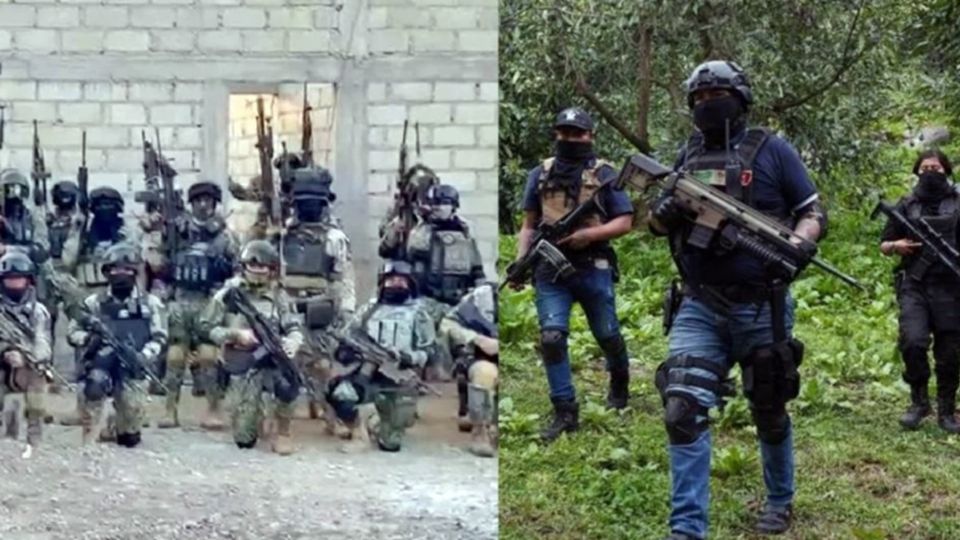

The head of the U.S. Drug Enforcement Administration (DEA), Terry Cole, stated that the Sinaloa Cartel (CDS) and the Jalisco New Generation Cartel (CJNG) are the top priority for U.S. authorities.
In a message shared on social media as part of the agency's "Fentanyl-Free America" operation, the federal official warned that fentanyl represents an unprecedented threat that has torn apart families and devastated communities.
"The Mexican cartels, Sinaloa and CJNG, are the DEA’s number one priority. The American people expect and deserve for the DEA to eliminate this threat, and that is exactly what we are doing."
Te podría interesar
Cole said the agency has made the fight against fentanyl trafficking the central pillar of its strategy and asserted that the DEA has never been more focused, united, or committed to that mission.
"We are hunting down the foreign terrorists responsible. That includes every facilitator, every distributor, and every person who profits from this poison. Fentanyl is an unprecedented threat."
ALSO READ: AMLO Concerned About U.S. Involvement in El Mayo Zambada Case: Sheinbaum
Targeting Mexican Cartels
Cole emphasized that the DEA is deploying the full weight of its global organization to combat fentanyl trafficking. Since the beginning of the current administration led by President Donald Trump, the agency has seized more than 14,000 kilograms of fentanyl and over 62 million fentanyl pills, equivalent to more than 478 million potentially lethal doses.
He added that the DEA has never been more focused, aligned, or dedicated to addressing the crisis than it is today, stressing that the agency has directed all its efforts toward fighting the cartels.
"We are pursuing the foreign terrorists responsible. We are going all in, with no limits."
These remarks come amid a tougher U.S. anti-drug policy under the 2026 National Drug Control Strategy, unveiled by the White House. The strategy includes objectives such as strengthening border security, combating money laundering, and disrupting the illegal trade in drug precursors. One of its most notable aspects is its approach to dealing with organizations designated as terrorist groups, including the possibility of actions extending beyond U.S. borders.
A History of Warnings
On June 2, Secretary of State Marco Rubio told a Senate hearing that Mexican cartels could eventually use drones against U.S. targets.
"Mexican cartels are using drones against one another, and we have to assume that at some point they could use them against us, against our interests."
Rubio said the issue is widespread around the world.
"It is a global problem. It is a global challenge, and it is happening every day around the world."
Context
The administration of President Donald Trump has designated major Mexican criminal organizations, including the Sinaloa Cartel and the Jalisco New Generation Cartel (CJNG), as terrorist organizations. It has also pressed the Mexican government to accept U.S. strikes against criminal groups operating in Mexican territory, a proposal that President Claudia Sheinbaum has rejected on the grounds that it would violate Mexico’s sovereignty.
In late May, Defense Secretary Pete Hegseth issued a warning directed at criminal organizations during a Cabinet meeting led by President Trump.
"We are going to war against the cartels," Hegseth told members of the administration, reflecting Washington’s increasingly aggressive rhetoric on border security and narcotics trafficking.
Earlier, on May 12, the Trump administration called on the Mexican government to intensify military operations against drug cartels in order to prevent the United States from having to intervene directly in Mexican territory.
During testimony before the House Appropriations Committee, Hegseth acknowledged that there is currently an "impressive and unprecedented" level of cooperation with Mexico’s Ministry of National Defense (Sedena) and Navy (Semar).
That same day, DEA Administrator Terrance Cole said that the criminal indictment against Sinaloa Governor Rubén Rocha Moya, who is currently on leave, and other officials was "only the beginning."
Speaking before the U.S. Senate, Cole argued that for years there had been collusion between drug traffickers and senior Mexican officials, but that "suddenly, we are paying attention to it."
Previously, on May 8, President Trump renewed his criticism of Mexico, insisting that drug cartels effectively govern the country and warning that his administration would act "very soon" on the ground as well to combat drug trafficking.
djh