



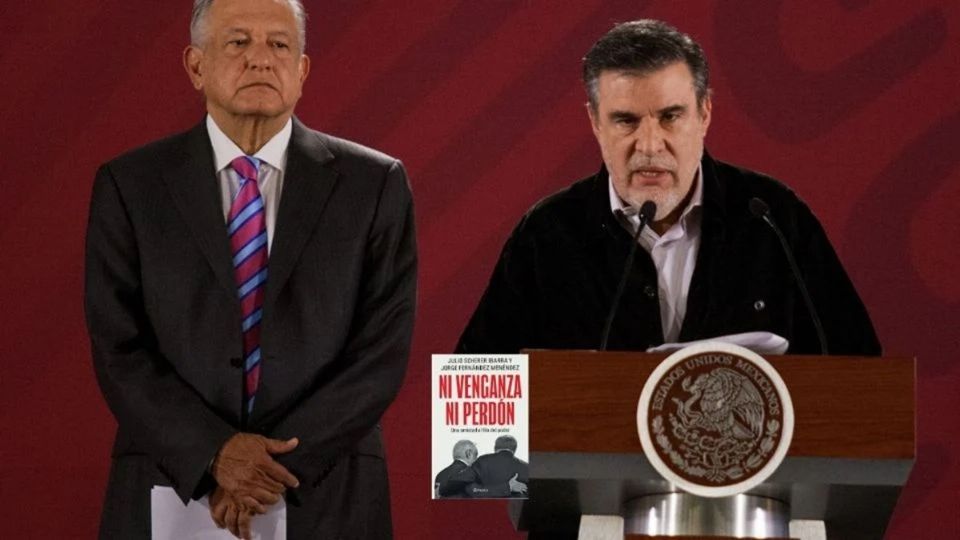

During three years, Julio Scherer Ibarra was one of the figures closest to Mexico’s president, Andrés Manuel López Obrador. When the lawyer stepped down from the Legal Counsel’s Office, the president did not hesitate to describe him as his “brother,” but warned him: “They’re going to come after you…”
With his resignation from the post, Scherer distanced himself from the politician he accompanied over the course of 20 years, although he did not break his relationship with him. After years of public silence and controversies with some of his former cabinet colleagues, he presents a book co-authored with journalist Jorge Fernández Menéndez in which he reveals intrigues within the cabinet, resentments of many actors that turned into public policies, and not a few acts of corruption, ambition, or simple incompetence displayed by figures such as Adán Augusto López, former Interior Minister; Alejandro Gertz Manero, former Attorney General; or Jesús Ramírez, former presidential spokesperson.
The resignation of figures such as Carlos Urzúa, due to his differences with Manuel Bartlett, director of the Federal Electricity Commission (CFE); the way in which Arturo Zaldívar’s arrival to the presidency of the Supreme Court of Justice of the Nation was handled; or the reasons for elevating Hugo López-Gatell to manage the pandemic are part of the account.
Te podría interesar
Prepared in the form of a conversation between the authors, the book narrates some of the most controversial matters of the previous six-year term of López Obrador.
Scherer does not judge or criticize the former president, but he does make negative remarks about cabinet members, such as Adán Augusto López, whom he holds responsible for the break with the Judicial Branch, but also for rushing the construction of the Dos Bocas refinery in Tabasco without having environmental permits.
Te podría interesar
Regarding Jesús Ramírez, he accuses him of running a network that enriched itself through alliances with businesspeople, a decree to liquidate workers of the Luz y Fuerza Company who had already received severance pay, and of establishing an alliance with Sergio Carmona, linked to organized crime, the so-called “king of fuel theft,” to whom, he assures, he even opened the doors of the National Palace for a meeting with then-president López Obrador.
Below are central excerpts from the text published by Editorial Planeta that begins circulating this Wednesday.
The subheadings are by La Silla Rota.
Adán Augusto: authoritarian and opaque
Scherer holds Adán Augusto López, governor of Tabasco and former Interior Minister of the López Obrador administration, responsible for the lack of dialogue with the Judicial Branch that resulted in a reform that, in his words, “has not been beneficial for anyone.”
“When we left the Government, Adán Augusto remained in charge of the argument with the Supreme Court. The president asked Adán Augusto for the Legal Counsel’s Office to depend on the Interior Ministry; if not formally, then as a way of operating. That is how it happened.
“During those three years, the relationship of the federal Executive Branch with the Supreme Court and with the Judicial Branch was complicated; it had its ups and downs, but it continued to function well: most cases moved forward. But, due to lack of dialogue, the following three years were a disaster, ending with the recent reform to the Judicial Branch, which in fact eliminates the Judicial Branch we knew.
“All of that could have been avoided with dialogue with judges and magistrates. I believe this reform could have been dispensed with, because there was no reason to carry out such a profound reform of the Judicial Branch as the one that was done.”
According to the former counsel, López Hernández tried to take advantage of the construction of the Dos Bocas refinery so that multimillion-dollar contracts would be awarded in absolute opacity.
“Regarding the refinery, after going back and forth many times, it was decided it would be built in Paraíso, Tabasco. The land chosen was full of mangroves. Between future secretary Rocío Nahle and then governor Adán Augusto, a construction company was brought in to tear down all the mangrove without obtaining the environmental impact permit (MIA) from the Environment Ministry.
“An initiative was later sent to the Congress of Tabasco stating that projects built with federal resources did not have to go through public bidding in the state. Everything located in Tabasco could be directly awarded instead of tendered. I asked the president for authorization to open a constitutional controversy to eliminate that law.”
Gertz, the vindictive one
Scherer accused Alejandro Gertz Manero, until January Attorney General of Mexico and now appointed Mexico’s ambassador to Great Britain, of using the institution to pursue his enemies and says he is ashamed of having promoted his appointment.
“What happened at the Attorney General’s Office (FGR) was sinister. I made the appointments of each of the public servants. It was my role to prepare the appointment document so the official could act with the power of the president of the Republic.”
He recalls proposing Alejandro Gertz Manero as interim prosecutor before Senate ratification.
“Honestly, an appointment whose mere proposal embarrasses me. But the president accepted. I informed Gertz that he would operate the Prosecutor’s Office. He initially said no, then accepted, saying he had always wanted to be prosecutor.”
Jesús Ramírez, manipulative
“Jesús Ramírez has a great facility for making enemies. His gossip and entanglements were dreadful. The only people he did not meddle with were those from the Defense Ministry (SEDENA) and the Navy (SEMAR).”
“One case with ongoing consequences was the relationship of Jesús Ramírez and other officials with Sergio Carmona, the so-called ‘king of fuel theft.’”
“Intelligence documents indicate that Ramírez Cuevas held meetings with Carmona, linked to fuel smuggling, illicit campaign financing and alleged ties to drug trafficking.”
Classified reports of the Mexican State place Jesús Ramírez Cuevas in several meetings with Sergio Carmona before his murder in 2021.
“Through Jesús Ramírez, strategic meetings were facilitated to secure financial support in key campaigns, including that of Américo Villarreal, now governor of Tamaulipas. The closeness between Ramírez Cuevas and Villarreal is documented through photos, campaign events and public messages. Carmona financed Morena and was part of the party’s electoral machinery in northern Mexico.”
Sánchez Cordero, by gender quota
In the chapter dedicated to the formation of the cabinet, the former counsel explains why Andrés Manuel López Obrador appointed retired justice Olga Sánchez Cordero as Interior Minister.
“Andrés decided it had to be a woman. He wanted the Interior Ministry to be different from what it had been. Olga Sánchez Cordero met the profile of a progressive woman and experienced Supreme Court justice.”
“It was the first time a president decided on a parity cabinet: half women, half men.”
López-Gatell and the pandemic
Regarding the handling of the covid-19 pandemic, Scherer says Andrés Manuel López Obrador ceded communication policy to Hugo López-Gatell and the Health Ministry.
“López-Gatell, an epidemiologist, had autonomy in communication. He had previously worked during the H1N1 pandemic under Felipe Calderón. The decision to place him in charge again was a mistake. As communicator and operator, the result was negative.”
He adds that the experience showed the difficulty of operating a single communication strategy during a public health crisis.
He references current president Claudia Sheinbaum and her continuation of the presidential morning press conferences as a communication instrument.
Álvarez-Buylla, a disaster
María Elena Álvarez-Buylla, winner of the National Prize for Sciences and Arts, was appointed head of Conacyt.
“Her tenure at Conacyt was marked by conflict. There were confrontations with the scientific community over issues such as native corn, glyphosate, and legal actions against researchers.”
Attempts to prosecute scientists were linked to actions promoted by Gertz Manero, according to the account.
Nahle, manipulated by Bartlett
According to Scherer, Manuel Bartlett, former director of the Federal Electricity Commission (CFE), influenced Rocío Nahle in energy policy decisions.
“The energy policy of the previous administration had a high cost, including the Dos Bocas refinery, where nearly 25 billion dollars were invested.”
“Dos Bocas was built under Rocío Nahle’s leadership. The budget was separate but assigned through Pemex. The merit or demerit of the refinery falls entirely on Nahle.”
He describes a close relationship between Bartlett and Nahle, while Octavio Romero, head of Pemex, maintained operational independence in the oil sector.
(With collaboration by Jorge Cisneros, Elizabeth Santiago, Marco Antonio Martínez, Otilia Carvajal, Erik López).
TAMBIÉN LEE: Conacyt de Álvarez-Buylla: problemas en CIDE y con EU por el glifosato, acusa Scherer Ibarra
TAMBIÉN LEE: Scherer: AMLO cesó a Irma Eréndira Sandoval por investigar corrupción de Bartlett Jr.
TAMBIÉN LEE: AMLO cambió objetivo de sus academias de beisbol, revela Julio Scherer en nuevo libro
VGB