





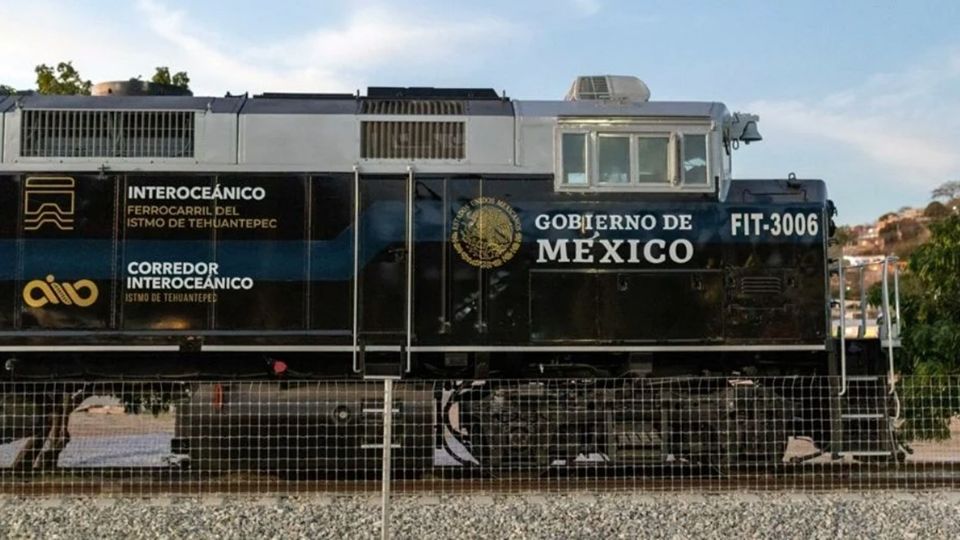

The Federal Audit Office (Auditoría Superior de la Federación, ASF) warned of technical and administrative deficiencies in the rehabilitation works of Line Z of the Interoceanic Train of the Isthmus of Tehuantepec, after documenting a lack of technical evidence and failures in construction oversight mechanisms, according to the 2023 Public Account Report.
The observations focus on the curvature and grade correction works carried out along the rail corridor connecting Coatzacoalcos, Veracruz, and Salina Cruz, Oaxaca, which the project itself had previously identified as technically complex due to its topographic conditions.
The section where a passenger train derailment was recorded features sharp curves, considerable slopes, and conditions that hinder standard rail operations and require strict operating protocols.
In addition, federal oversight bodies monitored the use of public resources allocated to the modernization of Line Z. In its 2023 Public Account Report, submitted in 2024, the ASF reviewed the project titled “Correction of curvature, grade, and connection on Line Z of the Isthmus of Tehuantepec Railway (Veracruz–Oaxaca).”
Te podría interesar
According to that report, the ASF detected administrative irregularities totaling 28.85 million pesos in the rehabilitation works of Line Z. Among the main findings, the audit body identified overpayments of 8.56 million pesos under contract FIT-GARMOP-OP-Z-17-2022, resulting from inconsistencies in the integration of unit price matrices corresponding to various construction items.
It also pointed to cost adjustments that lacked sufficient technical evidence in construction logs or progress reports. These findings led to audit observation notices, in which the ASF presumes possible damage to the public treasury, subject to the clarification or reimbursement processes established by current regulations.
The railway project itself notes that certain sections of the track present geometric and operational limitations, and therefore require correction works, greater supervision, and stricter operating protocols to ensure adequate safety and operating conditions.
According to official railway rehabilitation documents, the Isthmus of Tehuantepec Railway acknowledged that in different segments of Line Z it was necessary to carry out specific curvature and grade correction works, particularly along at least 56 kilometers of track, where curves of between 9 and 12 degrees and maximum grades of up to 2.2 percent are recorded. These characteristics, according to institutional documentation, limited train speed, load capacity, and operational efficiency, making intervention in the existing infrastructure necessary.
The Isthmus of Tehuantepec Railway has undergone multiple rehabilitation processes since its original construction, precisely because of the rugged geography of the Isthmus, a region marked by hills, mountainous areas, and abrupt changes in elevation. Official reports themselves acknowledge that certain sections of the corridor present conditions that require constant technical interventions to maintain rail operations.
Between 2020 and 2024, the Interoceanic Train project included engineering studies, geometric correction works, and comprehensive rehabilitation of the rail line, confirming that the technical complexity of these sections was already known and documented by the responsible authorities. The project’s official narrative states that these works aimed to adapt the existing infrastructure to longer and heavier trains, as well as to improve the continuity and reliability of rail service.
The derailment occurred on the stretch between Nizanda and Chivela, Oaxaca, an area where the rail line crosses a topographic transition that has historically required more demanding operating maneuvers. To date, authorities have not reported whether the exact point of the accident was part of the segments intervened with curvature and grade correction works, nor whether it had additional operating restrictions, such as specific speed limits or special circulation protocols.
Operational progress and recent context
Despite the administrative observations, federal authorities have highlighted operational progress of the project in official statements and public briefings. During 2023 and 2024, the Ministry of the Navy and the Interoceanic Corridor of the Isthmus of Tehuantepec reported the completion of the main rehabilitation of Line Z and the start of cargo and passenger train operations, including pilot services.
djh