





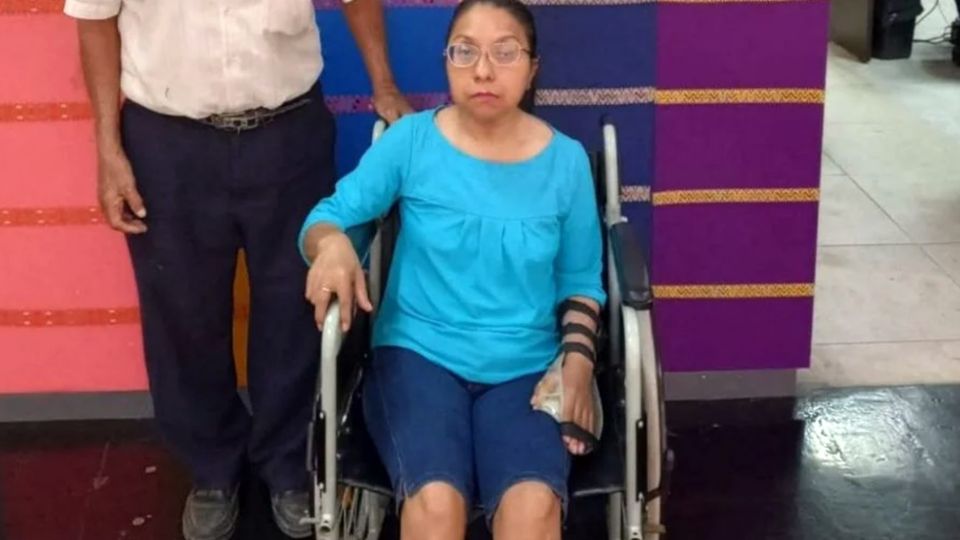

TUXTLA GUTIÉRREZ, CHIAPAS. — With a broken voice, difficulty linking words, and confined to a wheelchair since she was run over during work hours, Verónica Jaquelín Ordóñez Roblero faces a second battle that seems even more exhausting than the medical one: the fight for justice. Fourteen years have passed since the accident that changed her life, yet the beer company involved has still failed to comply with the comprehensive reparations to which she is legally entitled.
In an interview with La Silla Rota, Verónica’s legal adviser, Rosember Díaz Pérez, explains that although the case has won all injunctions and has had a “final” ruling since 2023, a series of “roadblocks” has kept enforcement stalled. He claims there is a conflict of interest linked to relationships between the owners of the responsible company and government figures, which, he says, has allowed the process to be mishandled and has deliberately prevented the execution of the judicial ruling.
The judgment orders the company to cover the medical expenses necessary for Verónica’s recovery, provide her with a minimum-wage salary to pay a caregiver, and guarantee her a lifetime pension. None of this has been carried out. As time passes, the family’s situation worsens: Verónica, a certified public accountant by profession, has a 16-year-old daughter who needs support to continue her studies; her husband left her after the accident, and her parents—now elderly—bear the emotional, physical, and financial burden of this long ordeal.
Te podría interesar
A life cut short
In April 2011, her family recounts, Verónica was working at an accounting firm in Tuxtla Gutiérrez. That day, at her boss’s request, she went out to review documents from a beer company for which the firm handled accounting services. She completed the task and, upon reaching the area near Plaza Ámbar in the eastern part of the city, a truck belonging to that same beer company struck her as she crossed the avenue to catch transportation.
The impact marked a before and after. Verónica spent three months in a coma and was later left in a vegetative state for some time. Her professional career came to an abrupt halt. The firm she worked for covered part of the compensation, and since then she has received a minimal pension from social security. But it is not enough. Her father and mother, both now elderly, have had to devote years, energy, money, and practically their entire lives to this long and painful “via crucis.”
For attorney Rosember Díaz, interviewed by La Silla Rota, the lack of justice not only prolongs the suffering but constitutes a form of revictimization, worsened by the obstacles imposed by a Public Court that has avoided enforcing the final ruling.
What is hardest, he says, is the sense of institutional abandonment: “It seems the responsible parties and the justice system itself are waiting for Verónica to die so they can close the case.” For this reason, he maintains that the case could even be brought before the Inter-American Court of Human Rights, considering that Verónica’s rights as a victim have been violated.
Threats and an uphill road
Rosember Díaz knows he is facing, in his words, a “monster.” The clearest example, he says, came a few months ago, when he received a direct threat from the legal representative of the company identified as responsible, who also serves as a government official.
The man warned him not to take the case “personally” and hinted that, as a young lawyer, his career could be “cut short over the next six years.” It was not an explicit threat, he admits, but serious enough to alarm him: “Someone who should be guaranteeing compliance with the ruling intimidates you… it becomes more complex.”
Amid the process, those affected have observed constant changes in the corporate names of the companies that should be responsible for repairing the damage. They currently appear under the names “Asesoría Comercial de Chiapas, S.A. de C.V.” and “Exclusivas de Tuxtla, S.A. de C.V.,” both represented by Manuel Francisco Antonio Pariente Gavito.
Meanwhile, Verónica’s life continues to be marked by the consequences of her traumatic brain injury: half of her body remains paralyzed. “I remember when I first met her,” Rosember recounts, “she was still lying in a crib; in that condition she even curled up… it was incredible to see.”
She has tried to give interviews, but her condition makes it difficult. At times she acknowledges that she frequently forgets things, part of her body and her head tremble, her speech is unclear, and she cannot walk. Despite her family’s efforts to strictly follow therapies and medical recommendations, her maximum recovery might reach only about 60 percent; the rest, specialists admit, is irreversible damage.
The lawyer explains that on September 3 they sent a letter addressed to President Claudia Sheinbaum Pardo, hoping the case will be addressed and that Verónica will finally receive justice.
djh