





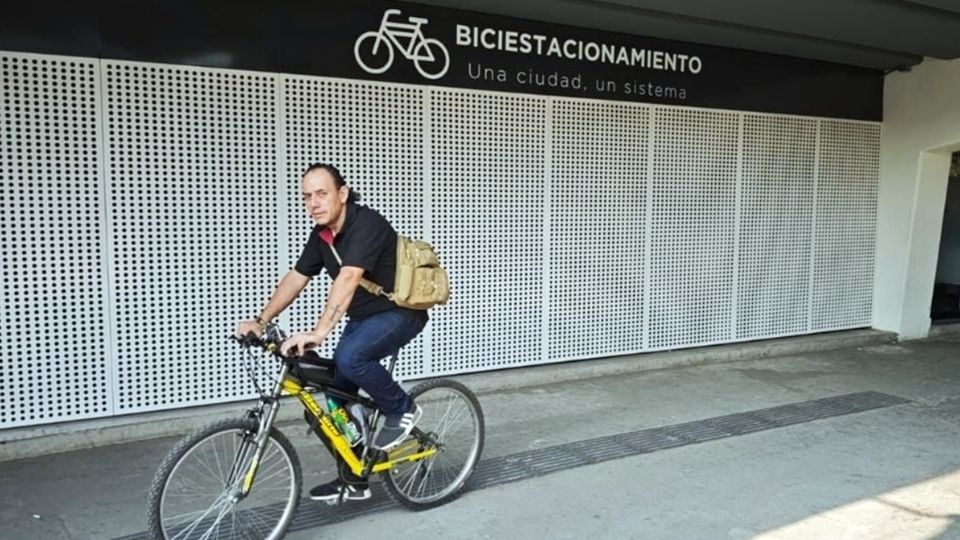

Two public bike parking facilities in Mexico City, built with resources earmarked for improving urban public space, remain closed, without maintenance, and out of operation.
These are the bike parking facility at the Insurgentes Roundabout, inaugurated in September 2024, and the Camarones bike parking facility, opened in 2020. During a site visit conducted by La Silla Rota, it was confirmed that both are abandoned, filled with trash, lack security, and have been vandalized.
Insurgentes bike parking facility inaugurated “in a rush”
The bike parking facility at the Insurgentes Roundabout, with capacity for 99 bicycles, was inaugurated in September 2024 as part of the comprehensive redevelopment project of the roundabout, four days before then–interim Head of Government Martí Batres left office.
Te podría interesar
The project cost 14 million pesos, funded through two trusts managed by the then–Ministry of Urban Development and Housing (Seduvi): the Zona Rosa Master Plan Trust (10 million pesos) and the Transfer of Development Rights Trust (4 million pesos).
However, former officials from the Ministry of Mobility (Semovi), consulted anonymously, stated that the project “was built in a rush” to finish it before the change of administration.
As a result, it was inaugurated without a security system or closed-circuit video surveillance, equipment that exists in other bike parking facilities across the city.
The temporary measure was to assign an Auxiliary Police officer to guard the site, with the expectation—according to the same sources—that the new Semovi would complete the equipment once Clara Brugada’s administration began. That did not happen, and within a few days the space was closed.
La Silla Rota requested information about the project from the current Semovi, headed by Héctor Ulises García, as well as an interview with a responsible official, but received no response.
Currently, the bike parking facility remains out of service, with access points closed, trash accumulated around the area, and a persistent smell of urine beneath the roundabout. The metal structure shows dirt and lack of maintenance.
Miguel, an employee at a nearby business, says that “the parking facility never worked” and that at times it is used by government personnel to store “vehicles or things.”
Cyclists unaware of the existence of the Insurgentes bike parking facility
The abandonment is such that even cyclists who ride through the area daily were unaware that a bike parking facility exists on Insurgentes.
This is the case of Jorge, who has worked in the area for more than five years and says he has never seen the space open.
“I didn’t know there was a parking facility here. It would be very useful if it worked, because many people come by bicycle and there’s nowhere to leave them. My friends have had theirs stolen. I would leave mine here without a problem.”
Just a few meters from the main entrance, shoe shiners who work at the roundabout offer bicycle storage for a voluntary fee. Several cyclists interviewed said they prefer this service due to the lack of formal alternatives.
Camarones: an abandoned bike parking facility whose cost no one can specify
The second case involves the bike parking facility located near the Camarones Metro station. It was inaugurated in April 2020 during the COVID-19 pandemic. It had more than 120 spaces, security cameras, on-site guards, lighting, and a tool totem. Operations ran from 6:00 a.m. to 12:30 a.m. the following day.
The facility was built as part of mitigation works for Plaza Destino Azcapotzalco and is located just a few meters from several bike lanes, including the Metropolitan bikeway that connects Ciudad Satélite with the capital.
“It had very good equipment, there was security, police presence, and it was very well maintained. It was used by both residents and workers—from tamale vendors and bakers to delivery workers. It was a very safe space, with cameras, lighting, and even a fence around it,” says activist Antonio Roa.
“You would arrive, register, and a guard would take a photo of your bike and your ID. They also gave you a token with an identification number; it was very safe. I would come, leave my bicycle, and go downtown by Metro,” the cyclist recalls.
La Silla Rota consulted Vidal Llerenas, the borough chief who promoted the project, about the cost of the bike parking facility; however, he said he “doesn’t remember,” but assured that “it wasn’t very expensive.”
“I don’t remember the cost; I’d be lying. It also wasn’t very expensive because the space already existed. What was purchased were the racks.”
The current Azcapotzalco administration and officials from the then Seduvi also did not provide this outlet with information about the budget used.
“Running the bike parking facility was very expensive”
Despite the investment, the bike parking facility was closed after Margarita Saldaña took office in 2021.
In an interview, the former borough chief said she made this decision because “operating the site was very expensive,” since, she said, they had to pay the salaries of three shifts of security personnel for a bike parking facility that “almost nobody used.”
She also maintained that the borough never had full possession of the facility because, being located under a bridge (on Aquiles Serdán Avenue), responsibility for the space lay with the Ministry of Urban Development and Housing (Seduvi).
“It operated for free; practically nothing was charged, but it wasn’t used. There was one security person assigned and the number of bicycles was very low—at most 10 bikes,” the PAN member stated.
However, residents argue that the bike parking facility was indeed used, but that from one day to the next, public registration to use the facilities was suspended, preventing new users from accessing the bike parking.
“The infrastructure was top-notch, but in January 2021 they no longer allowed you to sign up to leave your bicycle. Months later, they simply closed it and let it die, without any explanation,” says Fernando Rivera, a resident of the Clavería neighborhood.
Currently, Fernando is forced to leave his bicycle in the parking lot of Plaza Destino Azcapotzalco, located just a few meters from the abandoned facility, where he is charged 16 pesos per hour to park his bike.
“Surely the mall exceeded its capacity and they started charging,” he says.
Two infrastructures without use
As of today, both the Insurgentes and Camarones bike parking facilities remain closed.
One was inaugurated without security systems and stopped operating days later; the other operated with security and high demand, but closed after a change in administration, with no clarity regarding its cost.
djh