





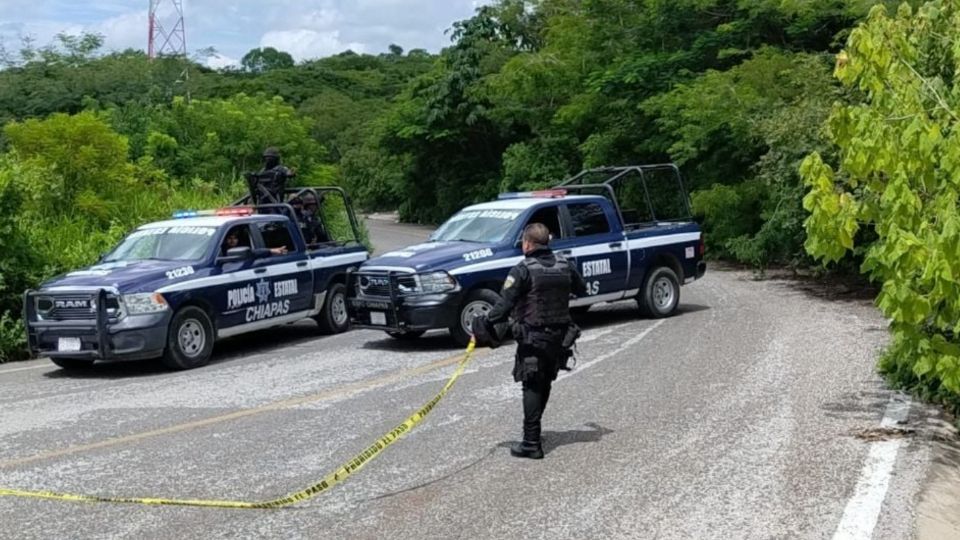

Tuxtla Gutiérrez, Chiapas — When the current state administration took office on December 8 of last year, one of its main mandates was to strengthen security to defeat organized crime and, above all, restore peace in Chiapas. Proof of this is the ongoing “clean-up” operation within various police departments since then.
Based on a request for information submitted by La Silla Rota to the Chiapas Attorney General’s Office (FGE), from December 2024 through October 25, 2025, 594 public servants have been detained, 84.3% of them municipal police officers.
Te podría interesar
The latest case involved the arrest of 16 officers from the municipality of Chilón, who blocked FGE agents in an attempt to “rescue” a detainee being transferred to Ocosingo. The man had been charged with gang activity and attacks on communication routes, La Silla Rota reported.
According to the agency, the incident occurred along the Bachajón–Sitalá highway, where the municipal officers intercepted the vehicle transporting Israel “N.” “The municipal police aggressively forced the arresting officers out of the vehicle and illegally freed the detainee, taking him away in a patrol car to an unknown location,” the FGE stated in a press release.
The first “show of authority” came on December 24, with the mass arrest of 93 public servants from Comitán de Domínguez who obstructed an operation by the Immediate Reaction Force Pakal (FRIP) and the FGE against extortionists.
A Surge of Collusion
In response, Eduardo Ramírez Aguilar, governor of Chiapas, admitted that the operation had not targeted the municipal police specifically but acknowledged that “the complicity between these groups, pseudo–social organizations, became evident—groups that extort residents and business owners.”
Over a month ago, 59 police officers from the Cintalapa municipal department were also detained, along with their director Ulber “N.” They were allegedly linked to the Chiapas–Guatemala Cartel and charged with misuse of badges, uniforms, and insignia, as well as criminal association.
According to the FGE data obtained through the information request, of the total 594 arrested public officials, 501 were municipal police officers. Others included 16 traffic officers, 10 FRIP members, 9 investigative police agents, 7 administrative workers, and 6 municipal police directors, among others.
Of those detained, 191 faced criminal prosecution, 16 await hearings, and 387 remain free pending investigation—meaning their release is conditional, and prosecutors may reopen their cases if new evidence arises.
The FGE further revealed that most arrests were concentrated in Tonalá (101), Comitán de Domínguez (93), Chiapa de Corzo (91), Cintalapa (68), Villaflores (42), Tuxtla Gutiérrez (39), Chilón (25), and Villa Corzo (25), among 21 other municipalities.
Police in Trouble
Iván Emmanuel Chávez Espejel, secretary of the National Network of Police Associations, said that while there has always been a relationship between “narcos” and politicians in Mexico, “there used to be a line—thin, but still a line. The criminals financed some political campaigns.” However, he lamented that during AMLO’s administration, that line disappeared: “Now the narcos are the politicians,” which explains the close ties between police and organized crime.
Chávez Espejel said that in Chiapas there are at least five municipalities where this dynamic is evident, such as Frontera Comalapa and several in the Soconusco region, “where the municipal president is part of organized crime.” He explained that when a mayor takes office, he appoints cartel lieutenants as police commanders, leaving officers with only two choices: join the mafia or resign.
“But what can an officer with 20 or 25 years of service do? Where can they go? Who will hire them? It’s almost impossible for a former cop to find civilian work due to the stigma of corruption,” he said, adding that many remain in the force, “keeping their distance” from criminal elements.
In a separate interview, Javier Jiménez Jiménez, local congressman for the Morena party, expressed concern about the growing number of arrests of public officials during this administration for various crimes. He said there must be stricter controls and “filters” to ensure that anyone responsible for public safety is loyal, serious, and responsible.
As chair of the state legislature’s Public Security Committee, Jiménez stressed that “no one is above the law or the people who simply demand safety.”
A Trail of Terror
As La Silla Rota has documented, during the three and a half years of the previous administration, led by former governor Rutilio Escandón Cadenas, violence surged to unprecedented levels, driven by drug cartels such as Sinaloa, Jalisco New Generation, Chiapas–Guatemala, and Los Huistas from Guatemala.
At the same time, new groups emerged, including the San Juan Chamula Cartel and self-defense forces like El Machete, from regions plagued by violence. Amid the clashes, disappearances, extortion, and mutilated bodies, the collusion of police officers at all levels, including senior commanders, became evident.
One example was the February 2024 execution of Germán Alegría, head of public security in Berriozábal, along with two of his colleagues, who were abducted and later found dead in Tuxtla Gutiérrez. A video circulated in which Alegría allegedly exposed links between public officials—including one from the state’s Public Security and Citizen Protection Secretariat (now SSP)—and organized crime.
Then-President Andrés Manuel López Obrador promised an investigation, but it never materialized.
An Uncertain Outlook
Iván Emmanuel Chávez Espejel, also president of Ciudadanos Uniformados A.C., believes the only way to “eradicate” corruption within police forces is for Morena to leave power. He lamented that in recent years the gap between police and organized crime “has grown dangerously thin.”
“It’s true that many police officers have been arrested for ties to organized crime,” he said, “but nearly as many have disappeared or been murdered by the cartels.” He noted that officers’ personal data are listed in the National Public Security Registry, including addresses and family information, which makes them easy targets. “When a new mayor takes office, his staff can access that data—and those who refuse to cooperate with criminals often have their families threatened.”
For his part, Morena legislator Javier Jiménez defended the work of the FGE and the State Public Security Secretariat (SSP), saying Governor Ramírez’s policies focus on citizen protection. Still, he acknowledged that “something is missing,” given the troubling number of incidents involving security personnel.
djh