





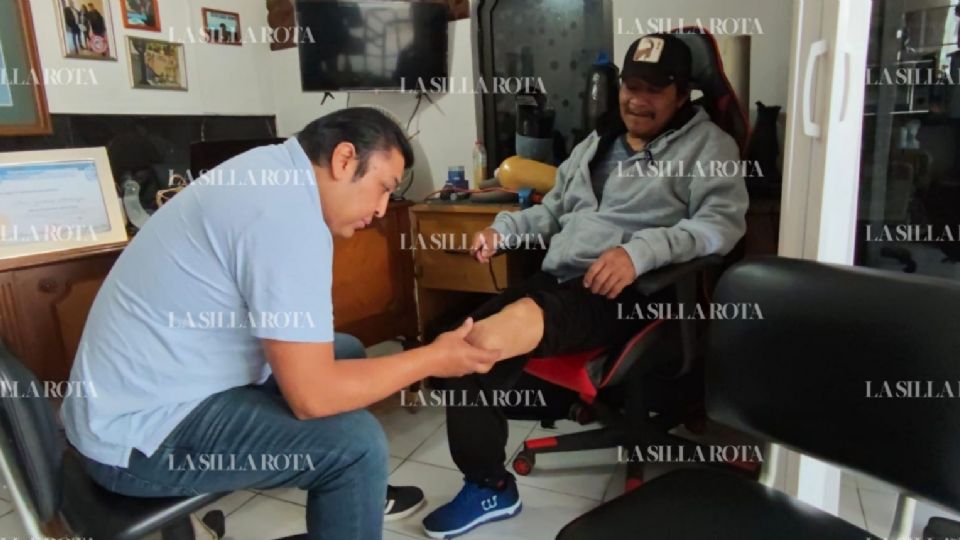

On the unpaved streets of Xochimilco, José Vega moves with difficulty. At 65 years old, after a leg amputation due to complications from diabetes, he gets around with an orthopedic walker.
“It gets stuck on the stones, I hardly leave the house anymore,” he says.
He used to sell nopales at the street markets in the south of Mexico City; now he spends his days at home, unable to work.
“It all started with pain in my pinky toe. It turned black,” he recalls in an interview with La Silla Rota.
Faced with the pain, like millions of Mexicans without social security, he went to a pharmacy clinic.
“The doctor told me I was fine, gave me some pills, and that was it.”
But the pain didn’t go away. Later, another doctor explained to him that an infection caused by his diabetes was advancing and that, if it wasn’t stopped, they would have to amputate his left foot.
“They tried to save it, but it was too late,” he says.
The amputation took place in February 2025 in a private clinic. Months later, his daughter looked for help in public hospitals in Xochimilco to obtain a prosthetic, but the process was long and confusing.
“They sent us around in circles and we can’t take that much time off work,” she explains.
They looked for alternatives, but private clinics were asking for over 60,000 pesos.
“Impossible,” he says.
That’s when they found an ad on social media for Mapili Prosthetics, an organization that offers affordable alternatives for amputees.
A response born out of necessity
Behind the project is Alan García, a young man from Xochimilco who uses 3D printing to manufacture low-cost prosthetics and serve those who, for various reasons, have been left out of the healthcare system.
“It all started with my father, who was missing some fingers on his hand,” he says.
“I wanted to give them to him as a gift, but one finger cost up to 40,000 pesos. I thought: if a finger costs that much, how much does a leg cost?”
He quit his job and spent a year studying digital manufacturing methods. Without a medical background, he learned from orthopedists and combined 3D printing with digital scanning to design custom-made, lightweight, and resistant prosthetics. That’s how Mapili was born—an initiative that, since 2016, has made more than 400 prosthetics at prices far lower than the market standard.
“A transtibial prosthetic costs between 90,000 and 110,000 pesos. We make them starting at 15,000,” Alan explains.
“The goal is for people to regain their mobility and independence without going into debt.”
Every day, around 75 people undergo amputations in the country, according to medical estimates based on reports from the Health Ministry.
The main causes are complications from diabetes—a disease that affects more than 14 million Mexicans—and motorcycle accidents, which in recent years have become a new source of amputations.
“Before, one out of every twenty patients came due to a motorcycle accident; now it’s two out of ten and many are young,” Alan warns.
If you rely on the public system, getting a prosthetic can take months—or even years. Social programs prioritize financial support, but no longer guarantee mobility devices.
“I’ve had patients who spent a year doing paperwork and were ultimately rejected due to their age,” he says.
“Others receive a pension, but not a prosthetic. And what they want is not money—they want to work.”
Prosthetics made with 3D printing
Mapili’s workshop, located in a converted house in Xochimilco, combines digital scanners and 3D printers that operate day and night. Each piece—from the socket to the foot—is designed to fit the patient.
“The scan ensures the prosthetic fits the stump precisely. That reduces the manufacturing time to less than a month,” Alan explains.
The material used is carbon fiber, which offers lightness and durability.
“Many patients are surprised by how light it is. I tell them it’s easier to break a bone than to break this,” he jokes.
The result is an ergonomic, long-lasting, and, above all, affordable prosthetic.
“I get people from Veracruz, Chiapas, or Tijuana. It’s cheaper for them to travel here than to buy a prosthetic in their own state.”
“People don’t want a pension; they want to walk”
Alan has seen many people come into his workshop in wheelchairs, depressed and feeling like a burden to their families. But a few weeks later, they walk out.
José Vega is one such case. He says that after losing his leg, he did receive a government pension, but he still can’t leave the house.
“The most important thing isn’t to give out financial aid,” says Alan García.
“It’s to provide mobility, to restore people’s dignity by allowing them to move again, work, and get ahead. That’s what makes them happiest.”
Context: In Mexico, more than 55% of workers are in the informal sector, according to INEGI, and therefore lack access to social security. For them, projects like Mapili offer an alternative to a gap the public system still hasn’t been able to close: the lost mobility of thousands of Mexicans.
“I don’t want to be stuck inside anymore,” says Don José.
“With the prosthetic, I want to walk again, even if it’s just to the corner.”