





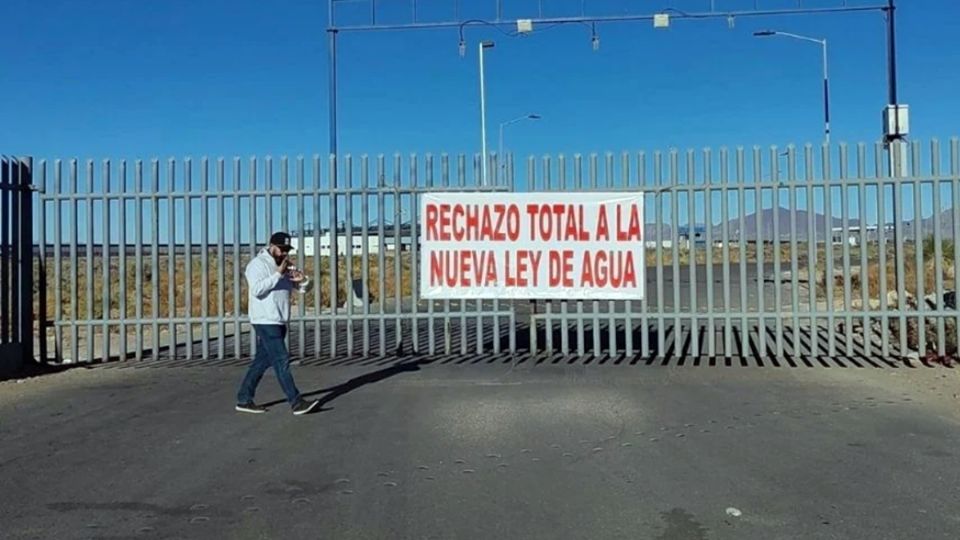

President Claudia Sheinbaum stated on Tuesday that she will not back down on the new National Water Law, whose goal is to restore water’s status as a resource belonging to the nation and to guarantee the human right to water, preventing it from continuing to be treated as a commodity.
Her statement comes amid blockades reported in various parts of the country, where opposing groups have expressed their rejection of the reform.
This past October, the federal government submitted the initiative to reform the National Water Law, which redefines the management and regulation of water resources in the country.
What are the key points of this Water Law?
The proposal prohibits treating water as a commodity, eliminating the transfer of concessions between private parties and any change of use without authorization from Conagua.
Te podría interesar
It proposes more efficient and sustainable water management, with shared responsibility between authorities and concession holders.
It promotes water reuse under principles of sustainability and environmental protection.
It reaffirms full respect for the rights of the agricultural sector, maintaining the autonomy of Irrigation Districts and Units to manage concessioned water according to their own rules.
The initiative seeks to strengthen public control of water resources and ensure their responsible use without harming the agricultural sector.
Scope of the reform to the National Water Law
Conagua will not be eliminated; rather, its technical and institutional role will be strengthened.
All users will retain the rights granted in their current titles: no law will be retroactive.
The rule remains that concessions may be extended for the same duration and under the same conditions originally established.
The reform does not encourage speculation or expropriation of titles; it seeks to provide legal certainty and reinforce state water management.
The rights of the agricultural sector will not be harmed; instead, irrigation modernization and access to programs such as PEUA will be promoted.
Administrative penalties for water misuse will be strengthened, and water-related crimes will be defined—not to criminalize users, but to curb practices that harm resource availability or foster corruption.
Context: At the start of the current administration, Conagua found incompatible databases, incomplete information, and a backlog of 145,000 procedures. This made a detailed review of each title necessary.
Conagua director Efraín Morales explained that the commission has carried out inspection visits based on 1,100 citizen complaints, mostly coming from areas with higher water stress.
To combat these practices, Conagua is reviewing a sanctions catalog to increase fines up to 50,000 UMAs, given that current penalties are not sufficient to deter illegal profit. In addition, the government plans to submit an initiative to reform the National Water Law and another to create a General Water Law.
The president has assured business leaders that they should not worry—“there’s nothing”—as long as they comply with the rules.
djh