






The implementation of Plan Michoacán, following the assassination of the mayor of Uruapan—who had denounced the federal government’s inaction against organized crime—brought back into public debate the violence that has plagued the state for more than 15 years.
On Monday, Michoacán’s governor, Alfredo Ramírez Bedolla, accused former president Felipe Calderón of igniting the wave of violence by responding to the request from then-governor Lázaro Cárdenas—now chief of staff to President Claudia Sheinbaum—to deploy federal forces against criminal groups.
The so-called “war on drugs” unleashed a wave of clashes between rival cartels, and that violence continues to affect communities today.
Te podría interesar
“We lived through that moment; all Michoacanos remember it. It was evident that the decision had negative consequences,” said Governor Ramírez Bedolla.
AMLO: The Peace That Never Came
A review of homicide statistics from Inegi shows that during the three six-year presidential terms since the war on drug cartels began, the highest homicide toll occurred between 2019 and 2024.
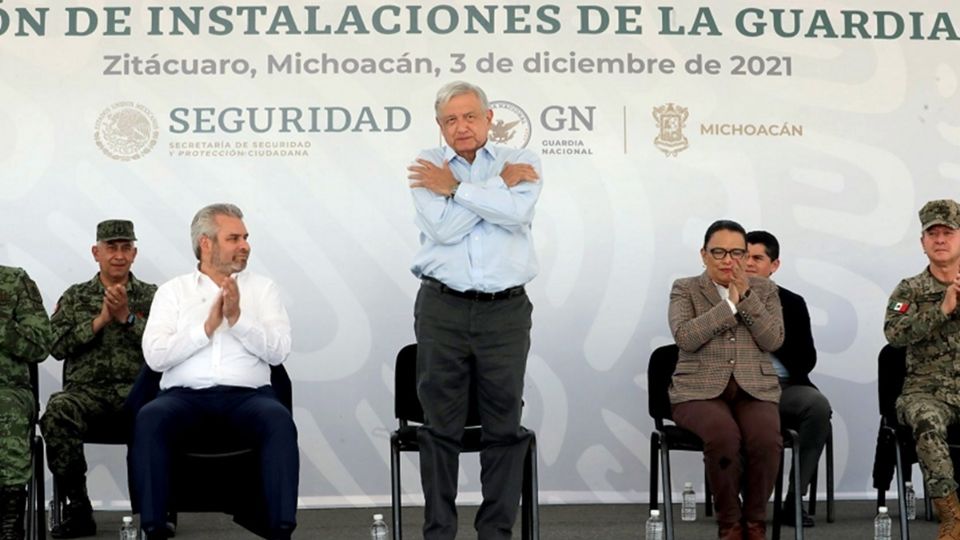
One of Andrés Manuel López Obrador’s key campaign promises in 2018 was to bring peace to Mexico by shifting security policy away from militarization and focusing instead on social programs aimed at preventing youth involvement in organized crime.
However, during that period, 13,253 homicides were recorded in Michoacán—nearly double the 7,000 reported under Enrique Peña Nieto (2012–2018) and three times the 4,538 recorded during Felipe Calderón’s administration (2006–2012).
According to data from the Executive Secretariat of the National Public Security System (SNSP), 868 homicides were registered in the state during the first nine months of 2025, compared to 1,246 cases in 2024.
Context: since 2007, at least three major strategies have been launched to contain criminal groups in Michoacán:
Calderón’s plan: Deployment of troops, launch of social programs, and the “Michoacanazo” scandal, in which several mayors were accused of protecting cartels.
Peña Nieto’s plan: Appointment of a special commissioner, Alfredo Castillo, to oversee pacification efforts, coordinate security operations, and fund self-defense groups originally created by farmers to combat extortion.
Present day: Some of those self-defense groups are now aligned with criminal organizations such as Cárteles Unidos, which the U.S. government has designated as a foreign terrorist organization.
The Failure of Social Programs
Francisco Rivas, director of the Citizen Observatory for Security, told La Silla Rota that both López Obrador and President Sheinbaum argue that social programs like Jóvenes Construyendo el Futuro address the root causes of violence and keep young people away from crime.
However, Rivas warns that this approach is biased, assuming that only low-income youth engage in criminal activity.
“If we look closely, there are countless cases of so-called ‘narcojuniors’—middle-class, upper-middle-class, or even wealthy young people—who got involved in criminal activities for other reasons,” he said.
According to Rivas, the problem is not the intention to address the causes, but rather the flawed diagnosis behind the policy.
“If the diagnosis is wrong, the treatment will also be ineffective.”
He estimates that the current social programs are long-term efforts whose impact may not be visible for another 20 years.
“It’s unrealistic to expect these programs to reduce crime rates in the short term—especially when we continue to face rampant impunity that allows crimes to go unpunished,” he concluded.
djh