





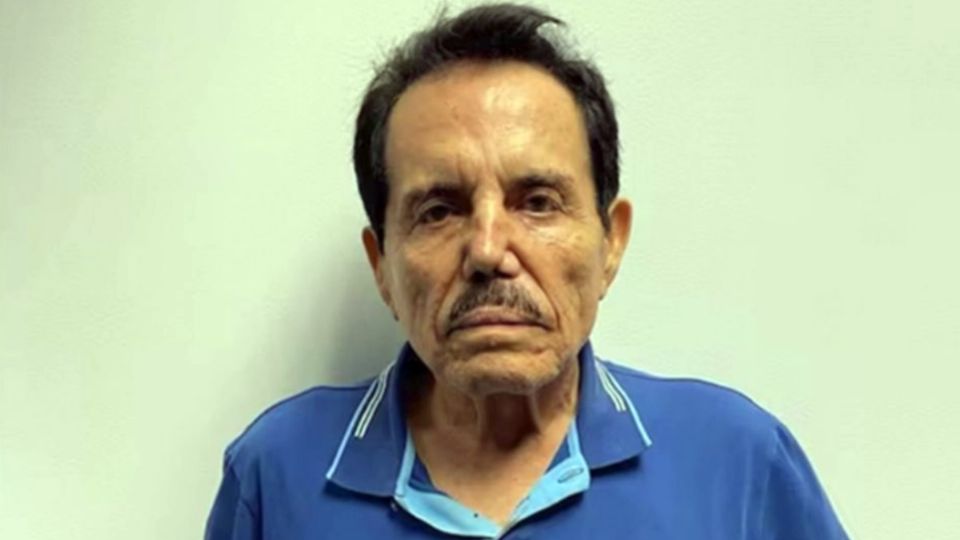

Mexican drug trafficker Ismael "El Mayo" Zambada was sentenced Monday to life in prison after being convicted by a U.S. court on cocaine and fentanyl trafficking charges.
Before sentencing, Zambada read a letter to U.S. District Judge Brian Cogan in which he apologized to the individuals and families affected by his actions and urged young people to avoid "making the same mistakes" he had made.
The hearing took place at the U.S. District Court for the Eastern District of New York in Brooklyn, where Judge Cogan—who also sentenced Joaquín "El Chapo" Guzmán to life imprisonment—handed down the sentence.
Te podría interesar
Zambada entered the courtroom limping and appeared to be in discomfort as he sat down. Dressed in a khaki prison uniform with an orange undershirt, he struggled to understand the judge despite simultaneous interpretation and also appeared to have difficulty moving.
Before the hearing, U.S. prosecutors asked the court to impose a life sentence and order the forfeiture of $15 billion. Zambada's defense team, meanwhile, requested that he be transferred to a federal medical facility capable of providing the healthcare they said he requires.
TAMBIÉN LEE: "Brother Wang": His Appetite for Risk Led Him Into Fentanyl Trafficking
"El Mayo" Apologizes
"I am not asking for compassion. I only want to say that I am sorry. The violence must end in Mexico. No one will win this war," Zambada said after learning his sentence.
The Sinaloa Cartel co-founder apologized before the judge prior to sentencing and called for an end to violence in Mexico and elsewhere.
"No one wins this kind of war," he said in Spanish during the hearing. "I cannot change what I did, but I can take responsibility."
Which Prison Will "El Mayo" Be Sent To?
Several weeks before sentencing, Zambada's attorneys submitted a letter to Judge Cogan acknowledging that, given the charges against him, he would spend the rest of his life behind bars regardless of whether he received a formal life sentence.
However, they asked that he be assigned to a federal medical prison, citing his health problems.
At sentencing, Judge Cogan declined to recommend a specific correctional facility but asked that Zambada's physical condition be taken into consideration.
The U.S. Federal Bureau of Prisons, the agency responsible for inmate placement, will determine where Zambada serves his sentence.
Federal prosecutors expressed reservations about the defense's request, arguing that "El Mayo" still maintains contacts that could pose security concerns.
His legal team is seeking to avoid his placement at the federal supermax prison in Colorado, where Joaquín "El Chapo" Guzmán is currently incarcerated.
"If They Capture Me or Kill Me, Nothing Changes"
Zambada, 76, was born and raised in the Mexican state of Sinaloa, part of the region known as the Golden Triangle—along with Durango and Chihuahua—which for decades has been one of Mexico's main drug-producing areas.
Unlike many other high-profile cartel leaders who openly displayed their power, "El Mayo" built his influence from the shadows. He portrayed himself as "just another farmer" and maintained a low profile for decades, allowing Mexican and U.S. authorities to pursue him unsuccessfully until 2024.
The son of farmers, Zambada lost his father at age 12. He worked in agriculture and later as a car wash attendant before entering the drug trade in 1969.
His rise coincided with the restructuring of organized crime in Mexico following the collapse of the Guadalajara Cartel in the late 1980s. Alongside Joaquín "El Chapo" Guzmán, Héctor "El Güero" Palma, and other associates, he became one of the founders of the Sinaloa Cartel.
"They said the same thing about (Pancho) Villa—that he was a terrorist. Now the United States is going to call us terrorists," Zambada told Mexican journalist Diego Enrique Osorno in 2021, in his last known interview before his capture.
Before sentencing, Zambada read a letter apologizing to the people and families affected by his criminal activities, calling for an end to violence in Mexico, and urging young people to stay away from drug trafficking.
Although the sentence did not include a financial fine, the court ordered the forfeiture of $15 billion—the amount sought by prosecutors as the estimated proceeds of his criminal enterprise.
In 2010, while still hiding in the mountains of Mexico, Zambada admitted he felt "panic" at the prospect of being imprisoned in the United States and said he had even considered suicide.
"If they capture me or kill me, nothing changes. Drug trafficking is embedded in society, just like corruption," he told journalist Julio Scherer in an interview for Proceso magazine.
Background
According to Mexico's Attorney General's Office (FGR), "El Mayo" Zambada arrived in the United States after being deprived of his liberty alongside Joaquín Guzmán López, a son of "El Chapo." The agency made that assertion after presenting the aircraft in which the Sinaloa Cartel co-founder was transported.
In a public statement, Ernestina Godoy, head of Mexico's federal security agency, said that, based on the official timeline, Zambada's alleged kidnapping coincided with the release of Ovidio Guzmán from custody, suggesting FBI and U.S. government involvement in the operation that led to his capture.
On Aug. 16, 2024, the U.S. Attorney General informed Mexico's FGR that Zambada had arrived in the United States against his will and that authorities were aware of several proposals made by Joaquín Guzmán López to surrender to U.S. officials.
On July 25—the same day Ismael "El Mayo" Zambada and Joaquín Guzmán López were taken into U.S. custody—the Federal Bureau of Prisons announced that Ovidio Guzmán, another son of Joaquín "El Chapo" Guzmán, had been released from federal prison on July 23.
djh