





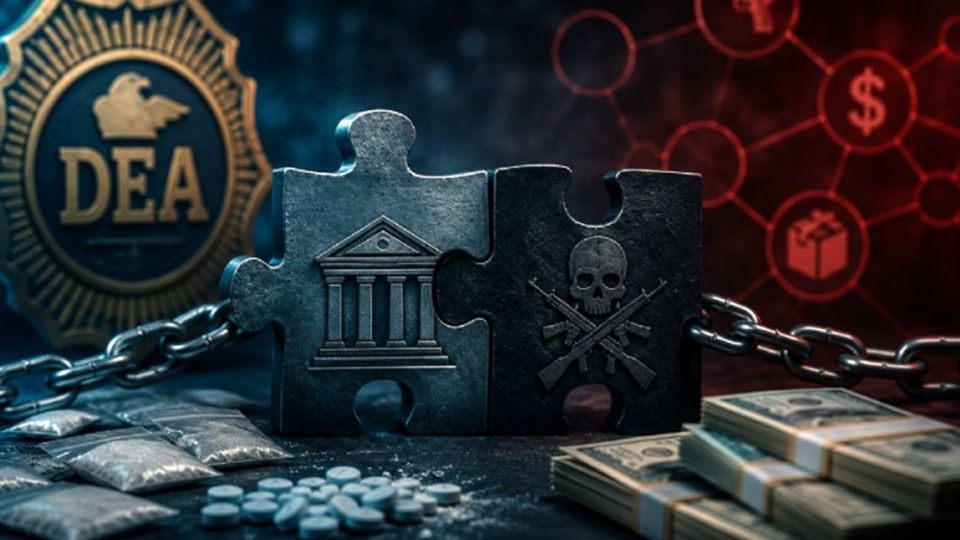

Terrance Cole, head of the U.S. Drug Enforcement Administration (DEA), said there is a link between Mexican criminal organizations and the country's federal government. He made the remarks during an official event in Orlando, Florida.
The U.S. official said both entities operate as a single working structure. The DEA described the relationship as a direct connection that has consequences for the American public.
Cole said the agency's priority is targeting those who facilitate and protect drug trafficking networks. The DEA also reported seizing 568 million doses of fentanyl in recent months.
Te podría interesar
"There is a deadly connection between the cartels and those in public office who enable their operations," Cole said.
Mexico's Security Cabinet responded Tuesday in a statement posted on social media. Federal authorities described Cole's remarks as allegations unsupported by evidence or verifiable facts.
"These statements lack factual support and do not reflect the publicly available and verifiable results presented by the Government of Mexico in its fight against criminal organizations," the statement said.
ALSO READ: Mexican Man Arrested in Argentina Over Alleged Drug Trafficking Ties; Wanted by Interpol
Mexican Government's Security Operations
Mexico's federal administration released a report highlighting security results to reject claims that it protects criminal groups. According to the document, authorities have arrested 59,582 people for various criminal offenses.
Security forces have also seized 31,366 firearms and 498 metric tons of narcotics during the current administration. The figures include 2,363 kilograms of fentanyl and more than 5.5 million fentanyl pills.
The government also reported dismantling 2,627 synthetic drug production sites. Under Operation Enjambre, 80 public officials have been prosecuted for alleged ties to organized crime.
Seven sitting mayors are currently facing criminal charges as part of those anti-corruption investigations. The Security Cabinet said the Mexican state does not grant immunity to anyone who commits crimes.
Official figures also show a 48% decline in the country's daily average of intentional homicides, equivalent to 41 fewer killings per day, according to government data.
Judicial Investigations in Washington
Todd Wallace Blanche, acting U.S. attorney general, is set to appear before the Senate as part of his confirmation process. Blanche is overseeing investigations involving 10 current and former Mexican officials accused of alleged criminal ties.
The U.S. prosecutor confirmed that one of the ongoing investigations involves a sitting Mexican state governor. U.S. authorities have designated the Sinaloa Cartel and the Jalisco New Generation Cartel (CJNG) as foreign terrorist organizations.
Mexican President Claudia Sheinbaum has asked the administration of President Donald Trump to provide evidence regarding the case involving Sinaloa Governor Rubén Rocha Moya. She said the allegations have political motives.
U.S. authorities have relied on criminal prosecutions and the extradition of cartel leaders to obtain testimony involving local politicians. Bilateral relations have faced renewed tensions over investigations related to the transfer of Ismael "El Mayo" Zambada.
Political Context of Bilateral Relations
Border security has become a central political issue in the United States and is frequently used to mobilize voters. Mexico remains a key focus because of its geographic proximity and extensive trade relationship with the U.S.
Donald Trump has tied the stability of import tariffs to progress in the fight against drug trafficking. According to the article, this strategy seeks to shift attention away from challenges within the U.S. healthcare system.
The article also argues that insufficient oversight of pharmaceutical companies in the United States has contributed to the opioid crisis and that the U.S. government has avoided a broader debate about the role of domestic drug distributors.
Changes to Mexican law have restricted the DEA's operational freedom in the country and eliminated certain benefits previously available to its agents. Those reforms have generated friction with U.S. intelligence agencies that operated in Mexico.
The upcoming review of the United States-Mexico-Canada Agreement (USMCA) has also become part of Washington's broader security agenda. According to the article, the U.S. government has used these issues as leverage in advancing its strategic interests.
djh