





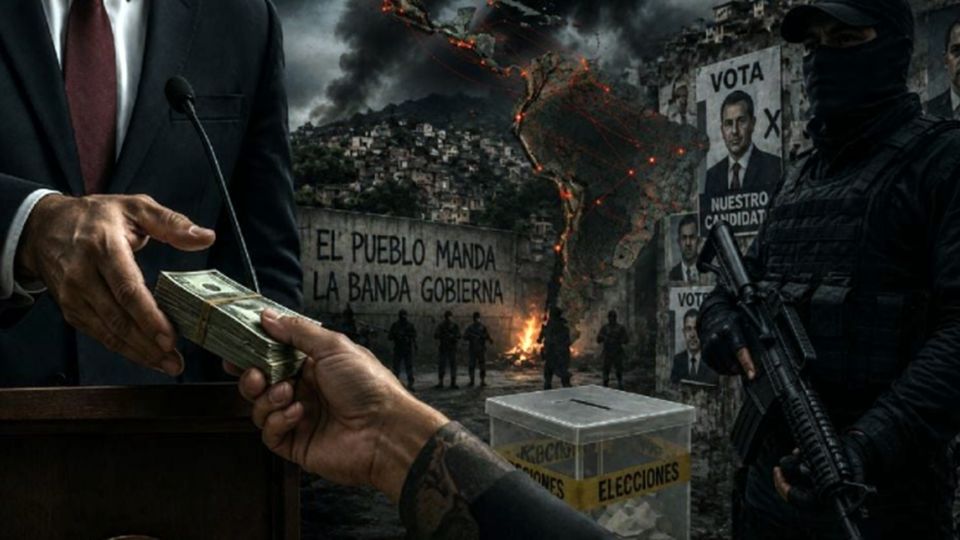

Organized crime in Latin America has evolved far beyond a public security issue. Criminal networks now directly challenge formal political power across several nations. Transnational gangs finance electoral campaigns and seize control of strategic public resources to capture government institutions.
These criminal organizations distort elections from their institutional foundations. The scale of the threat places four countries in the region among the ten most politically violent in the world. Many analysts have labeled this modern phenomenon "democracy at gunpoint."
Data from the Armed Conflict Location & Event Data Project (ACLED) show a steady increase in attacks against political figures. Armed incidents rose from 25,989 in 2018 to a historic high, with databases recording 28,315 events in 2025.
Te podría interesar
The Rise of Criminal Governance
Drug trafficking organizations seek to strip the state of its monopoly on the legitimate use of force. Criminal groups intervene directly in the making of local laws, while mafia networks coerce mayors and elected legislators to expand their illicit businesses.
ALSO READ: “The Chapo Congresswoman” Tells Her Story With “El Chapo”: From Stylist to the Drug Lord’s Escape
This criminal model establishes a form of governance that guarantees near-total impunity in neglected territories. Constant fear among the population erodes the legitimacy of the traditional representative system. As insecurity grows, many citizens lose their willingness to participate in elections.
Only 26 percent of people living in areas affected by violence say they are satisfied with the political system. By contrast, approval approaches 48 percent among residents who feel safe. Widespread fear reshapes public preferences regarding democratic governance.
Homicides Spread Across the Caribbean
The consequences of this phenomenon create a cycle of weak economic and institutional performance. Violence discourages foreign investment and stalls human development initiatives. Elected authorities lose their autonomy, while civil society becomes hostage to armed groups.
The narcotics crisis is no longer confined to mainland Latin America. Caribbean nations are now experiencing an unprecedented wave of violent deaths. The homicide rate across the subregion averages 27 killings per 100,000 inhabitants.
That figure exceeds the average for the rest of Latin America, which stands at 20 homicides per 100,000 people. Caribbean institutions face mounting financial pressure from the flow of illicit shipments and criminal proceeds. The stability of these island nations is under severe strain, weakening social cohesion.
The Danger of Hollow Democracies
Experts argue that law enforcement agencies must urgently regain territorial control. Illegal money from criminal organizations diminishes the true value of every citizen's vote. Free and fair elections require an environment where candidates can campaign without the threat of violence.
If the problem persists, elections risk becoming little more than a bureaucratic exercise. The firepower of criminal groups replaces the will expressed at the ballot box. The international organization warns that the continent could see its democracies transformed into hollow shells—institutions that exist in form but are ultimately controlled by armed actors.
djh