





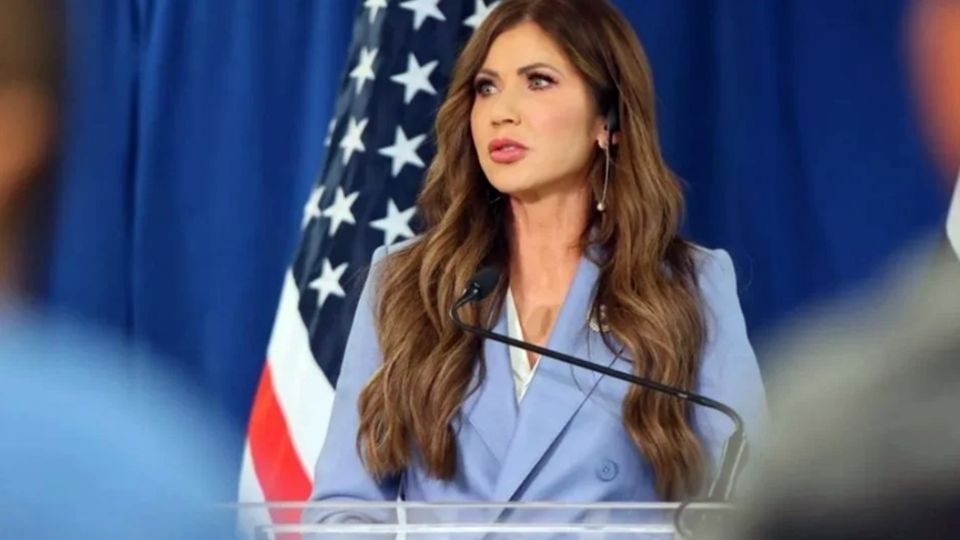

U.S. President Donald Trump announced Thursday that the secretary of the Department of Homeland Security (DHS), Kristi Noem—also known as “the migrant hunter”—will leave her position effective March 31, 2026, and will be replaced by Oklahoma Senator Markwayne Mullin, while the agency remains closed due to lack of funding.
The president was reportedly angered by the performance of the now former official during her appearance before Congress on Tuesday, March 3. Through his social network, Truth Social, the president announced the official’s departure following controversy surrounding her immigration policy, which had previously been backed by Trump himself, who said it had achieved “historic results.”
“I am pleased to announce that the highly respected United States Senator from the great state of Oklahoma, Markwayne Mullin, will assume the position of United States Secretary of Homeland Security (DHS) beginning March 31, 2026. (…) I thank Kristi for her service to her country,” the Republican wrote.
Te podría interesar
Trump also indicated that Noem—who “has served us effectively and achieved numerous and spectacular results (especially at the border!)”—will become Special Envoy for the Shield of the Americas, a new security initiative in the Western Hemisphere that will be announced next Saturday in Doral, Florida.
Trump’s Anger
During her hearing before the Senate Judiciary Committee, Noem stated that Trump had approved a $220 million advertising campaign promoting the self-deportation of migrants—something the president denied and which reportedly triggered his anger.
The secretary of the Department of Homeland Security (DHS), Kristi Noem, appeared before the Senate Judiciary Committee in a hearing where she faced intense and tough questioning regarding the immigration crackdown carried out by Donald Trump’s administration.
While the administration defends what it describes as “historic results,” opposition lawmakers have denounced systematic violations of civil rights and excessive use of force by federal agents.
Allegations of Unconstitutional Tactics
Since January, Democrats on the House Homeland Security Committee had warned that DHS Secretary Kristi Noem would face impeachment if she was not fired or resigned from her position following the events in Minneapolis, where ICE agents had already killed two U.S. civilians amid protests against immigration enforcement operations.
“Kristi Noem has destroyed public confidence in her ability to lead DHS. She lied about Alex Pretti,” Democrats on the panel posted Tuesday on the social media platform X.
During the session, Democratic Senator Dick Durbin accused Noem of leading a department “without a moral compass” that has sown chaos by detaining citizens based solely on their skin color, accent, or language.
Tensions escalated as lawmakers recalled the deaths of Renee Good and Alex Pretti in January, who were killed by gunfire from federal agents during protests against immigration raids. Noem, although expressing condolences, denied having labeled the victims as “terrorists,” saying she had only stated that the events appeared to resemble that type of incident.
Democratic lawmakers, including Chris Coons, argued that DHS has acted unconstitutionally in order to meet deportation quotas demanded by the White House. They also denounced the existence of “roving patrols” conducting operations in sensitive locations such as churches, hospitals, and schools, arresting even children, refugees, and people with disabilities.
Senator Cory Booker was among the harshest critics, demanding the secretary’s resignation or impeachment, arguing that the agency is “out of control” and systematically violating the right to peaceful protest.
Official Defense and Expulsion Figures
In response to the criticism, Noem defended DHS’s management, stressing that detentions at the border have fallen to historic lows and that, since the start of Trump’s second term in January of last year, nearly three million undocumented migrants have been expelled from the country. The secretary rejected accusations of abuse, arguing that Democrats are trying to prevent the government from removing “dangerous criminals” from the streets.
Kristi Noem’s Media Campaign in Mexico
Kristi Noem, now former U.S. Secretary of Homeland Security, led a multimillion-dollar advertising campaign in 2025 against irregular migration, with ads designed to warn people planning to migrate and to encourage “self-deportation,” including messages broadcast on Mexican free-to-air television, digital platforms, and social media.
These spots began airing in April 2025, appearing during soccer matches, in prime-time slots, and also across social media.
The campaign was part of a broader strategy strengthened by the U.S. government to discourage irregular migration and, according to reports, is scheduled to last several years and includes significant investment in international advertising.
The content generated outrage in Mexico, particularly because of its aggressive and stigmatizing tone toward migrants and the perception that the messages represented a form of foreign propaganda with discriminatory effects.
Political Response in Mexico: Bill to Ban Foreign Propaganda
The airing of Kristi Noem’s ads in Mexican media, taking advantage of a preexisting legal loophole after the 2014 reforms, prompted a response from the Mexican government and led to a legislative initiative.
Claudia Sheinbaum’s Initiative
On April 21 and 23, 2025, President Claudia Sheinbaum Pardo announced and sent to Congress a reform to the Federal Telecommunications and Broadcasting Law aimed at prohibiting the broadcast of foreign propaganda in Mexican media.
The central objective of the initiative was to restore and strengthen the article that had previously prevented foreign governments or entities from purchasing advertising space for political, ideological, or commercial propaganda on radio, television, and digital platforms accessible in Mexican territory, with the exception of cultural or tourism-related content.
The reform includes financial penalties for broadcasters and platforms that transmit such prohibited foreign propaganda—including fines proportional to their revenue—and grants oversight authority to new institutions such as the Agency for Digital Transformation and Telecommunications.
The initiative was received by the Senate of the Republic in April 2025.
What Exactly Would Be Prohibited?
The initiative proposes that the following would not be allowed to be broadcast in Mexico:
- Political, ideological, or commercial propaganda from foreign governments or entities.
- Paid advertising purchased by foreign governments in traditional media and digital platforms.
- Messages that directly influence domestic affairs or that are part of foreign campaigns with political or public security objectives.
djh