





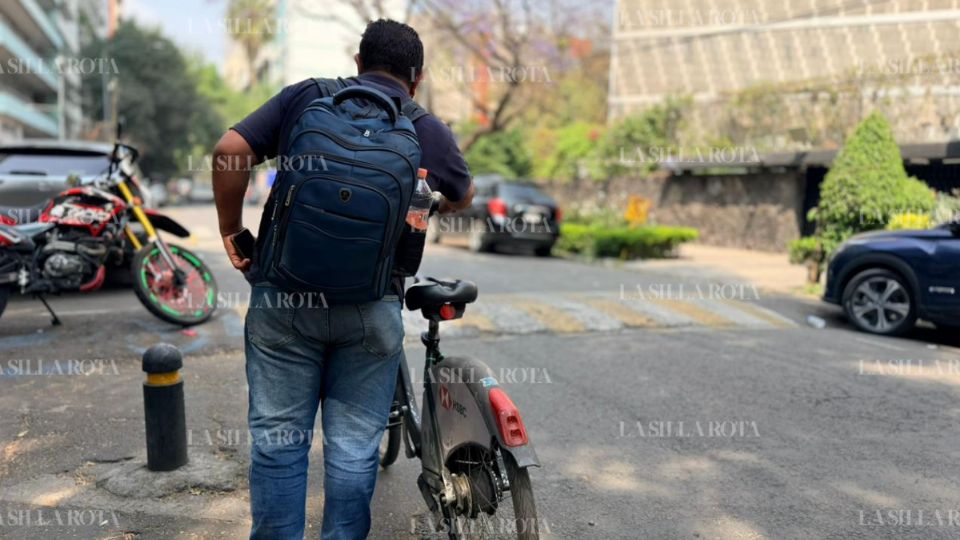

The expansion of the EcoBici system — which included the purchase of 15,000 bicycles before the start of the World Cup — remains pending with less than three months left before the tournament begins.
The system currently keeps about 9,300 units in operation, a figure that users consider insufficient to meet the city’s daily demand.
During a tour carried out by La Silla Rota, it was found that many of the bicycles available have mechanical failures, damaged seats, or that stations lack bikes during peak hours.
Te podría interesar
The problems are not new. In December 2024, La Silla Rota documented that a significant portion of the bicycles in the EcoBici system already showed visible deterioration, with broken seats, flat tires, and faulty brakes that complicated everyday use for riders.
The promise of expansion before the World Cup
On June 3, 2025, during World Bicycle Day, Mexico City Mayor Clara Brugada announced an expansion of the system toward the southern, eastern, and northern parts of the city.
During that event, the mayor said the city’s network of bike lanes would grow by an additional 300 kilometers and that the EcoBici system would add new units to reach 20,000 bicycles in operation during her administration. Of that total, she said 15,000 would be available before the World Cup, when the Mexican capital expects to receive thousands of visitors.
However, with just over three months remaining before the international tournament, the fleet remains close to 9,300 bicycles.
Users visit several stations to find a bike
La Silla Rota visited several EcoBici stations in the neighborhoods of Polanco, Condesa, Roma Sur, Doctores, and San Pedro de los Pinos, where bike shortages and units with mechanical issues were confirmed.
In Polanco, for example, at the corner of Horacio Avenue and Hegel Street, there are three stations in the system that together offer space for 93 bicycles. However, at the time of the visit, only five were available, and at least two of them had mechanical issues.
One of the users trying to take a bicycle at that moment was Eduardo. When he placed his card on the reader, the station did not respond, so he had to walk to another station a few meters away to try again.
“Sometimes it doesn’t read the card like right now. I just put the card in and it didn’t work. With the app I hope it works,” he said while trying to unlock a bike.
When he failed, he decided to try the adjacent station. “Here it worked,” he finally said after successfully unlocking a bicycle.
Before starting his ride, Eduardo explained that he always checks whether the unit is in good condition since many often have problems. “First I check the tires to make sure they’re not flat. Then I check the brakes,” he said.
The same problem affects Isamar, who uses the system daily to commute from Polanco to Buenavista. She describes the service as deficient, saying that on several occasions it takes her between 10 and 20 minutes to get a bicycle.
“Many times we can’t find a bike, and in Buenavista the docking spaces are full. Leaving a bike there is very difficult,” she said.
Mechanical failures cause accidents
In addition to the lack of availability, some users say mechanical failures have caused dangerous situations while riding around the city.
That is the case for Ximena, a frequent user of the system, who says the condition of several bicycles has put her at risk.
“I always have to take at least the second bicycle because many don’t work. Either they don’t have a bell or they don’t have brakes, and that’s the most important thing,” she said in an interview.
On one occasion, she recalls using a bicycle whose front brake did not work. When she tried to stop as a car approached, she had to rely solely on the rear brake.
“The bike stopped horribly because it didn’t have the front brake. I almost skidded,” she recalled.
“Maintenance first, expansion later”
For mobility specialists, before proposing an expansion of the system, the priority should be to guarantee that the bicycles already in operation function properly.
Bernardo Baranda, Latin America director of the Institute for Transportation and Development Policy, said the system’s main challenge right now is not only increasing the number of units, but ensuring the existing ones receive timely maintenance.
“It’s good to be ambitious, but right now what’s needed, more than talking about major expansions, is maintaining what we already have. Just like the Metro, the most important thing is maintaining the current system — then expansions are welcome,” he explained.
The problem with EcoBici is repair time
For Baranda, one of the main problems with the system is how quickly mechanical issues are addressed.
“Beyond expansion, what’s very worrying is that there are quite a few bicycles that are not being maintained as quickly as they should be,” he said.
“The most serious issue is when there aren’t enough bikes, when bicycles are in poor condition, or when a user has to walk around searching multiple stations,” he added.
The specialist also mentioned that another challenge for the system is the rebalancing of bicycles between stations — a logistical process aimed at ensuring availability at points with higher demand.
Even so, he said he still hopes that the projects announced by the city government can be completed.
“Making promises is easy, but implementing them is the hard part,” he concluded.
EcoBici use drops after complaints about failures
Reports about deficiencies in the service coincide with a recent drop in system usage.
For the first time in five years, EcoBici saw an interruption in its growth trend, closing 2025 with 20.1 million trips — a 9.6% decrease compared with the 22.2 million reported in 2024.
The reduction represents a loss of more than 2.1 million trips in a single year, after the system reached its historical peak in 2024.
La Silla Rota consulted Mexico City’s Secretariat of Mobility (Semovi) about the current status of the system, the number of bicycles and stations currently operating, and progress on the announced expansion to 15,000 units.
The agency was also asked when the new bicycles will begin operating and in which boroughs the new stations will be installed, as well as the planned timeline for implementation. However, at the time of publication, no response to the information request had been received.
djh