





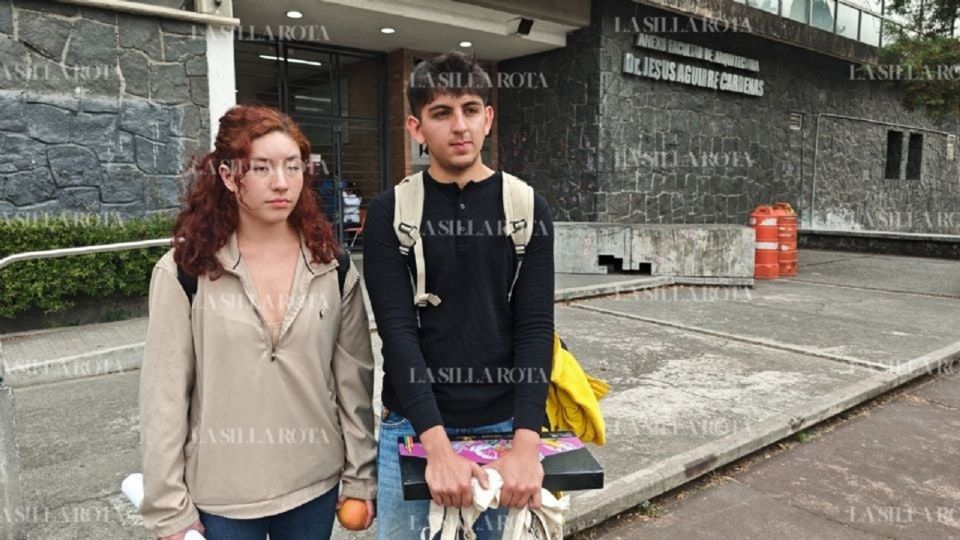

The Faculty of Architecture at the National Autonomous University of Mexico (UNAM) has been on a strike from in-person activities for three months. Authorities stated that 70% of activities are taking place at the faculty, while the student assembly denounced actions that have hindered the resolution of the current conflict.
In an interview with La Silla Rota, Cecilia González, a faculty professor, said that professors have resumed activities at a 70% level and that the Center for Industrial Design Research (CIDI), an annex of the faculty, is currently operating.
“Seventy percent of professors are already engaging with students and having this dialogue. The facilities that remain closed are the main building and the workshops,” she emphasized.
Te podría interesar
Carolina and Víctor, students in the Industrial Design undergraduate program, stressed that the CIDI recently distanced itself from the strike.
“We continue to support the Architecture cause because the problems have still not been resolved. It’s just that not having access to the facilities is already affecting us a great deal,” the student said.
Why did Architecture go on strike?
Context: On September 22, 2025, the Architecture community brought attention to the case of Jorge, a student at the faculty who took his own life by jumping onto the Metro tracks at the Copilco station. Following the incident, students reported an excessive academic workload, mistreatment by professors, and the inability to maintain a balance between personal life and school.
This led to an indefinite strike that took shape in October 2025, and the assembly emphasized that the guiding axis of their list of demands is mental health, approached from different angles.
On this issue, Carolina, who spent a year in Architecture before transferring to Industrial Design, said that the constant tension experienced in that faculty is real.
“What doesn’t happen here is what happens in Architecture, where professors try to humiliate students or a very toxic environment is created. I did experience it and I did suffer it, but while I was in Architecture. Not so much here,” she said.
Víctor agreed with the student and added that their degree program involves long hours of study that are exhausting for each of them.
“We share that it harms our mental health because we usually don’t have free spaces for leisure or time off due to the excessive schedule, and on top of that there are usually assignments. Even though conditions here feel very heavy, we know we are in better conditions than over there,” he said.
Obstacles to returning to classrooms
Cecilia noted that one of the conflicts that damaged communication occurred during the dialogue table on teaching, which was attended by professors with “labor issues.”
She added that the student assembly requested that dialogue be conducted through a tripartite assembly (students, professors, and workers), but that this was “beyond the faculty’s scope.”
The student assembly stated that there has been no resolution due to the unwillingness of administrators to address the demands at their core. In addition, in a statement, they reported the leaking of personal data and smear campaigns on social media against students and professors close to the assembly.
Along with this, they said that the student community was willing to hand over the facilities to lift the strike, but the process led to a disagreement that resulted in an academic strike, which they say is not recognized by UNAM.
Meanwhile, the current semester is at risk, and the 2026-2 term will begin on February 3, putting more than 4,000 students at risk, according to Cecilia González.
Mental health dialogue table
Cecilia emphasized that on January 20 a dialogue table on mental health was held, at which a new protocol for student care was proposed. According to the agreement shared by the professor, the protocol includes the following:
Prevention, psychoeducation, and promotion of well-being.
Screening and early detection.
Stepped care according to the needs of the student, academic, or administrative community. The person requesting care will be assigned to the appropriate services based on their level of symptoms and risk.
This will include four approaches: a Gender Perspective, Cognitive Behavioral Therapy (CBT), Systemic Therapy (ST), and Life Skills (LS).
Regarding this dialogue table, the student assembly rejected the meeting and described it as an exercise in “simulation.”
djh