



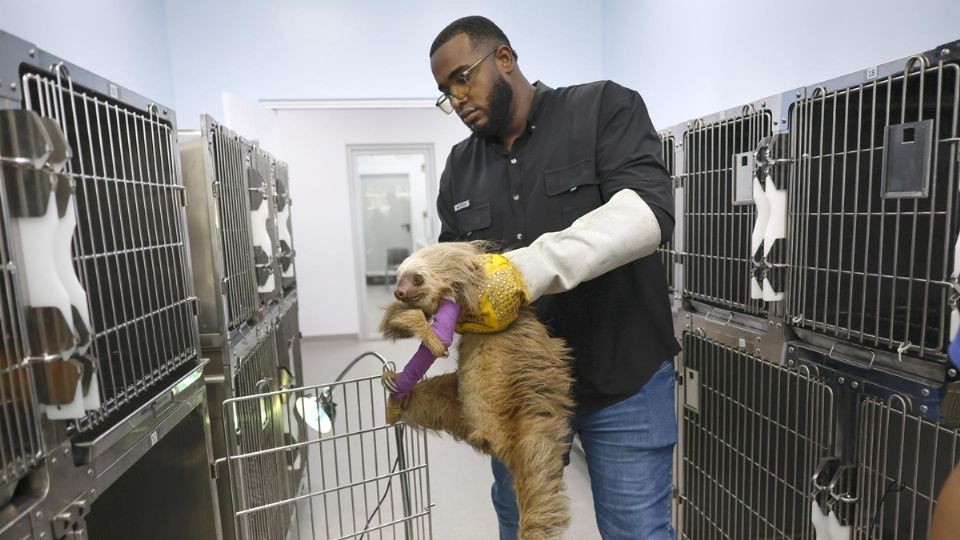

Undernourished, disoriented, and displaying altered behaviour, dozens of wild animals rescued from illegal trafficking arrive at the Ministry of Environment's veterinary clinic in Panama, where a team of specialists cares for them in the hope of one day returning them to their true home, the jungle.
"Our clinic provides timely care for national wild fauna, not exotic animals or pets. This ensures that they can fulfil their biological function and contribute to their ecosystem," says the clinic's medical director, Lissette Trejos, speaking to EFE.
Located within the lush Camino de Cruces National Park, the public clinic has treated over 750 trafficked, injured, or sick animals, as well as those with domesticated behaviour due to being kept as pets from an early age, which makes survival in their natural habitat difficult.
Inside, the howling of monkeys mingles with the singing of parrots, while felines display their sharp teeth. They are all "hospitalized," with some having already been through the operating room and others ingesting medication on a silver gurney.
Trafficking of animals
Other animals await the resolution of their "legal situation" due to being trafficked, as this is a complex process. According to clinic experts, birds are the most trafficked animals, while felines and primates are often kept as pets.
"We also receive animals due to illegal trafficking and the illicit trade, where wild fauna is held without any documentation. Much emphasis is placed on the fact that certain animals are not permitted to be held in custody, such as primates and large felines," the director highlights.
However, as Trejos recalls, birds such as parrots and parakeets "have been kept as household pets for many years, from generation to generation."
According to data from the Prosecutor's Office, 55 cases of wildlife crimes were registered in Panama in 2024, of which 36 were for "extracting protected or endangered wild, aquatic or terrestrial resources or species" and 18 were for species trafficking.
Meanwhile, 32 cases of attacks against wildlife have already been registered so far in 2025, based on official data updated as of Jun. 30. Of these, 27 are for extraction and five for smuggling of these animals.
Teaching a feline to "hunt"
This is the case with ocelots, a type of wild feline, which behave like domestic cats. Instead of adopting a defensive posture, it lies down inside its cage and extends its paw to play. It was a "pet" from birth, and when it arrived at the clinic weeks ago, it wore a knitted vest.
"When they come from confiscations, pet ownership, or illegal trafficking, these animals have some kind of ethological problem. Their behaviour is most affected," explains the clinic's biologist, Jhomar Návalo, to EFE.
The veterinarians are now acting as its "mum" to teach it to hunt before it is reinserted into its habitat, as it currently has low chances of survival. In contrast to the ocelot's friendly behaviour, a black jaguarundi (another type of feline) is more inclined to intimidate. It sits in a corner of its cage, baring its sharp fangs.
"Many animals already have innate behaviour, but there are others that don't. With felines, for example, the mother teaches her cubs to hunt and eat prey, so when these animals don't acquire that from their mother, we have to replicate it," says Návalo.
Back home
Since the clinic opened its doors in February 2025, experts have been receiving animals, assigning them a traceability number, conducting preliminary evaluations and diagnoses, and beginning rehabilitation programs so that they can be returned to their natural habitats.
The process for domesticating ocelots can be lengthy, as veterinarian Maricarmen Franco explains to EFE: "Human interaction must be reduced, except when receiving medical treatment." "First, we separate the animal from its environment, and then we gradually adapt and change the animal to the new surroundings," she says.
However, experts are also conducting research to facilitate the reintroduction of animals, particularly primates, in order to accurately identify their area of origin.
"We are trying to establish a bloodline baseline to identify exactly which area each primate comes from, in order to successfully reintroduce them to their natural habitat," says biologist Návalo.